File 1
Five of 26 state phone laws filed under “bell to bell” use the phrase
Education Week files 31 jurisdictions under “Bell to bell” in its chart of state phone rules. Of the 26 texts read, five contain the phrase.
Education Week’s Bell to bell row appears to sort laws by how much of the day they reach, which would make this a gap between a label and statute wording. The count measures the words of each law. How strong a law is takes another reading.
- Status
- Draft
- Dated
- November 5, 2026
- Responsible
- SOVRINT Inc.
- Corrections
- None
Draft. AI agents gathered the sources and wrote this, and no person has checked it yet.
To pass this on, the sample briefing puts it in a short document, also as a PDF.
3Phrase defined and used in the rule
- Georgia3 times
- Oklahoma2 times
- Virginia6 times
2Phrase in a title, act name or heading, and the rule says school day
- Arkansas3 times
- Pennsylvania2 times
5No phrase, but a bell mentioned another way
- Maine
- Maryland
- New Hampshire
- North Dakota
- Utah
16No phrase and no bell wording in the phone rule
- Alabama
- Arizona
- Florida
- Idaho
- Illinois
- Indiana
- Kansas
- Louisiana
- Missouri
- Nebraska
- New Jersey
- New York
- Ohio
- Rhode Island
- South Carolina
- Texas
Observed
The finding
How 26 was reached
- Listed in the row
- 31
- Not acts of a legislature (District of Columbia, Hawaii, Oregon)
- −3
- Not read in this pass (California, Vermont)
- −2
- Texts read
- 26
Education Week keeps a chart of state rules on student phones. Its largest row, Bell to bell, listed 31 jurisdictions when the page was last updated on October 26, 2026. Setting aside three entries that are other kinds of instrument and two texts not read in this pass leaves 26 enacted or final texts, each searched for the phrase.
Five contain it. Georgia, Oklahoma and Virginia define it and use it in the rule. Arkansas has it in the name of the act and Pennsylvania in the title and a heading, while the rule in both says school day. Of the other 21, five mention a bell some other way. Maine writes “from starting bell to dismissal bell.” Sixteen have no bell wording in the phone rule.
Assessed
None of this counts against the laws. The row appears to sort by how much of the day a rule reaches. In a keyword pass, 28 of its 31 summary cards use words such as school day or dismissal, and none of the eight cards in the Instructional time row does. Education Week has not stated its method. North Dakota shows why wording alone can mislead: its law says instructional time, then defines that as the whole school day, lunch included.
An assessment made in drafting of the term that sets the span in each rule: school day in 15 (counting academic school day and Florida’s lower grades), instructional day in 3, the phrase itself in 3, school hours in 2, and school time, instructional time and on school property in 1 each. Arkansas and Pennsylvania count under school day.
Observed
The count shows where the phrase appears in the text of the laws one tracker files under that label. How often people use the phrase, what the laws do in practice and how strong they are all stay open. Many of them reach the whole day in other words.
Case-insensitive search for bell[ -]+to[ -]+bell in the text read, with line numbers removed. Text shown struck through is left out of the count. Each state is listed with its address, so anyone can repeat the search.
What could move the count
- The ceiling is 10 of 31, if all five uncounted instruments carried the phrase.
- Idaho, New Hampshire and Ohio were read as current code. Any session-law title went unseen.
- Ten of the 26 are code or a late print, which can differ from the act as signed.
- Education Week can change the row. This count is for the page updated October 26, 2026.
- Illinois, Indiana, Pennsylvania and Utah refused the last automated check. Those four rest on copies kept from earlier passes.
Observed
Twelve dated lines
The twelve lines fall in six of sixteen years
- from the beginning of the class period to the end (bell-to-bell)National Science Teaching Association blog
- From bell to bell there is no cellThe Post Newspaper (Galveston County, Texas), on Texas City ISD
- Bell-to-Bell Instruction: Designing for Student Engagement and SuccessEducation Service Center Region 11 (Texas), workshop catalog
- No Cell from Bell to BellWNYT, on Lee Middle and High School
- bell-to-bell phone-free policiesFairplay, release with the Phone-Free Schools Movement
- “Bell-to-bell” includes lunch and time in between class periods.Virginia Department of Education bulletin
- Bell to Bell, No Cell ActOffice of the Governor of Arkansas
- Statewide, Bell-to-Bell Restrictions on Smartphones in SchoolsOffice of the Governor of New York
- No Cell Bell to Bell - Student Cell Phone UseGilbert High School (Gilbert Public Schools, Arizona)
- commonly referred to as a “bell-to-bell” banBallotpedia News
- “No Cell Bell to Bell” RuleSeattle Public Schools
- (bell-to-bell, instructional time, etc.)Federal Register, FCC proposed rule, document 2026-16590
Each row opens its entry in the lines in full below. An empty year there means no line was chosen from it, and the phrase may still have run that year. In the notes below, niche means a specialist audience, local one community, state a state body and national the whole country. Download the lines as CSV.
The 12 lines are chosen examples with no sampling frame. They show no rate and no order of adoption, and a class-period use from December 2022 falls after the first phone use. Lines before 2019 are education sources and most later ones are news or government, so any apparent shift may partly reflect what was read. Each quoted line is Observed: the wording was on the page when retrieved for this file on November 5, 2026, whether or not any claim inside it is correct.
Observed
Three meanings
One class period
The time from the start of a class to its end, in dated uses from 2011 and 2022.
In teaching the words have named a class period. A 2011 science teachers’ blog spelled it out as “from the beginning of the class period to the end.” A Texas education service center ran a workshop on bell-to-bell instruction in December 2022.
Assessed
That sense is likely still in use among educators. Confidence in that judgment is low, because December 2022 is the latest dated use read.
Phones, the whole day
No phones from arrival to dismissal, usually including lunch.
For phones they can mean the whole day. On August 17, 2019, The Post Newspaper reported a Texas City rule under the line “From bell to bell there is no cell.” That is the earliest phone use found. Earliest observed source does not establish original authorship. In September 2024 Virginia’s education department said the term “includes lunch and time in between class periods.”
Phones, class time
No phones in class, with lunch and passing periods left open.
Some schools use them for class time alone. Gilbert High School in Arizona posted a grades 9 to 12 rule named “No Cell Bell to Bell” on July 25, 2025, and it allows phones at lunch and in passing periods. Seattle’s high schools took the same name in April 2026. The Seattle Times reported the superintendent saying the words there refer to “the bells that start and end each class period.”
Observed
The lines in full
from the beginning of the class period to the end (bell-to-bell)
National Science Teaching Association blog (archived copy). See also ERIC record, 2009
2012 to 2018
No line chosen.
From bell to bell there is no cell
The Post Newspaper (Galveston County, Texas), on Texas City ISD
2020 to 2021
No line chosen.
Bell-to-Bell Instruction: Designing for Student Engagement and Success
Education Service Center Region 11 (Texas), workshop catalog
2023
No line chosen.
No Cell from Bell to Bell
bell-to-bell phone-free policies
“Bell-to-bell” includes lunch and time in between class periods.
Virginia Department of Education bulletin. See also Executive Order 33, archived copy
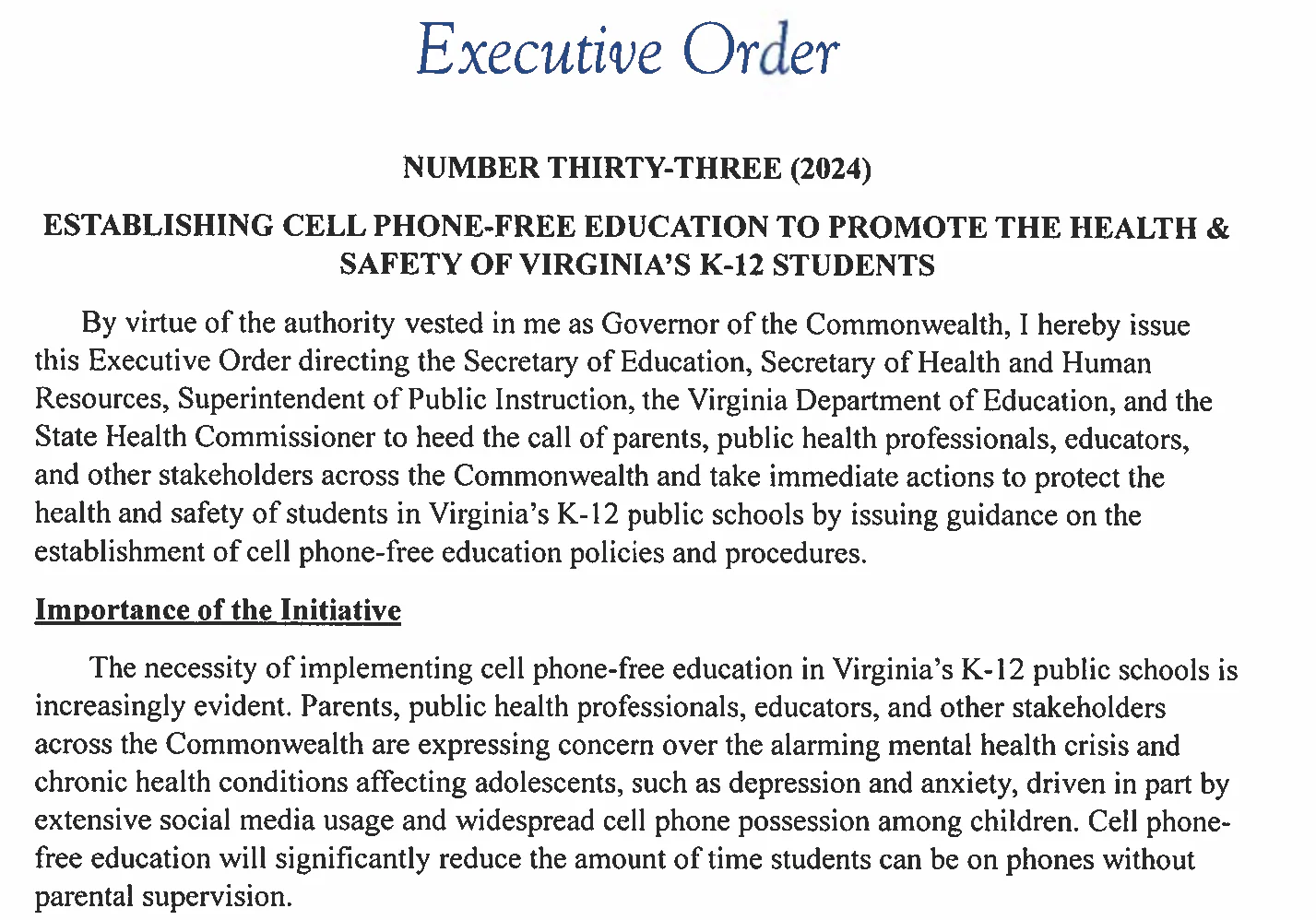
Virginia’s order names its subject “cell phone-free education” in the title and three more times on the full page. Commonwealth of Virginia, Office of the Governor (archived copy, Internet Archive), July 9, 2024. Highlight added. Source Bell to Bell, No Cell Act
Office of the Governor of Arkansas

Section 1: “This act shall be known and may be cited as the ‘Bell to Bell, No Cell Act.’” Arkansas General Assembly, February 20, 2025. Highlight added. Source Statewide, Bell-to-Bell Restrictions on Smartphones in Schools
No Cell Bell to Bell - Student Cell Phone Use
commonly referred to as a “bell-to-bell” ban
“No Cell Bell to Bell” Rule
Seattle Public Schools. See also The Seattle Times, on GovTech, April 30, 2026
(bell-to-bell, instructional time, etc.)
Federal Register, FCC proposed rule, document 2026-16590
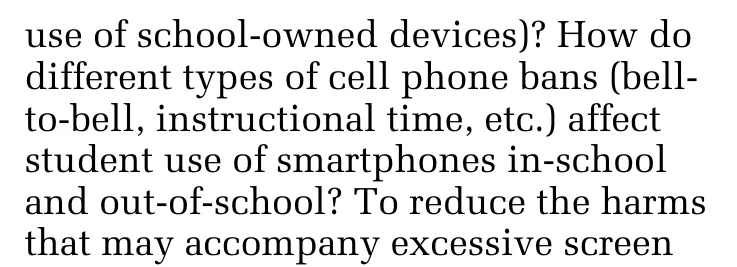
Federal Register page 52634: “bell-to-bell” appears as a type of ban, beside “instructional time.” Federal Communications Commission, Federal Register via govinfo.gov, August 14, 2026. Highlight added. Source


Observed
The 26 texts
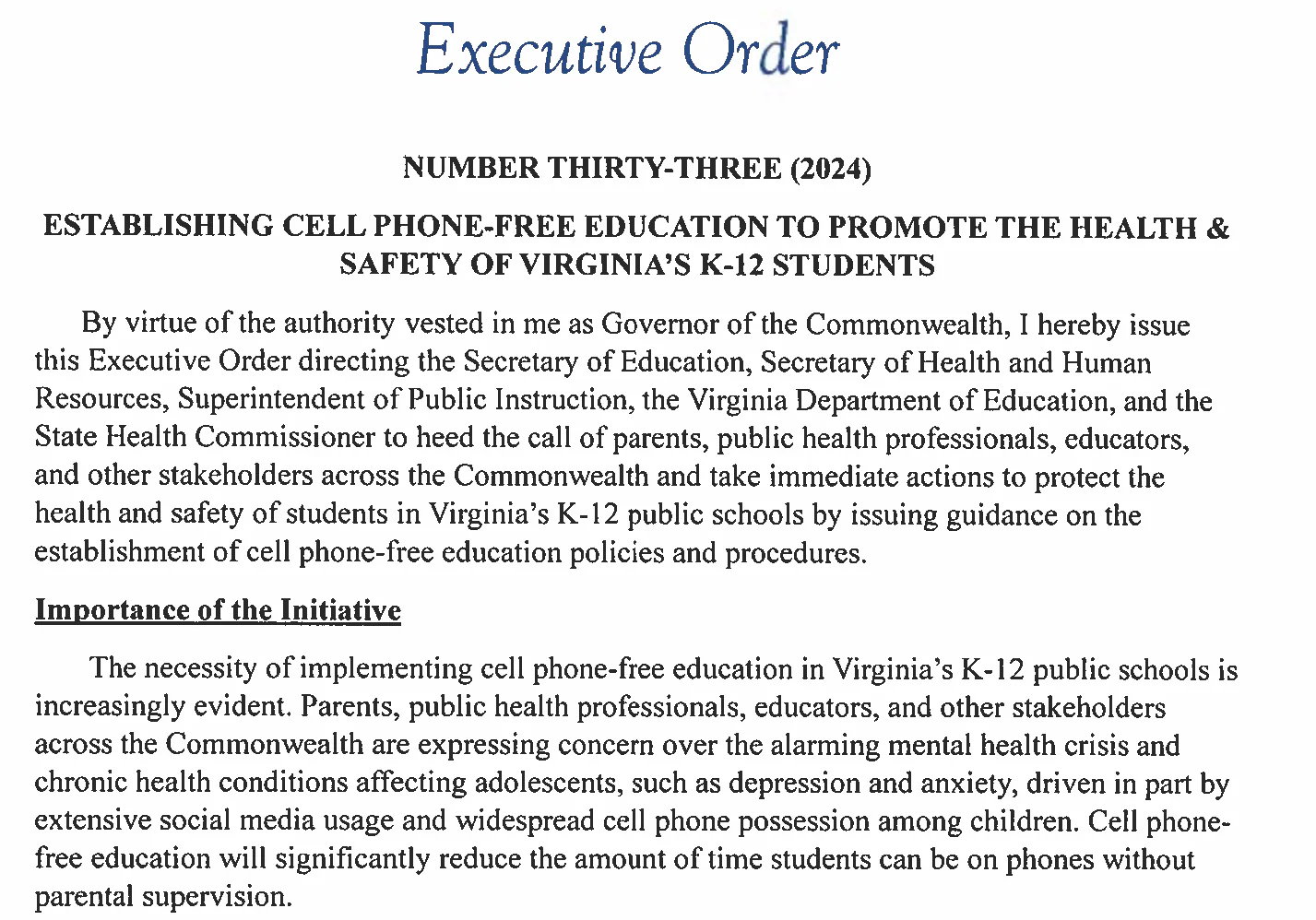
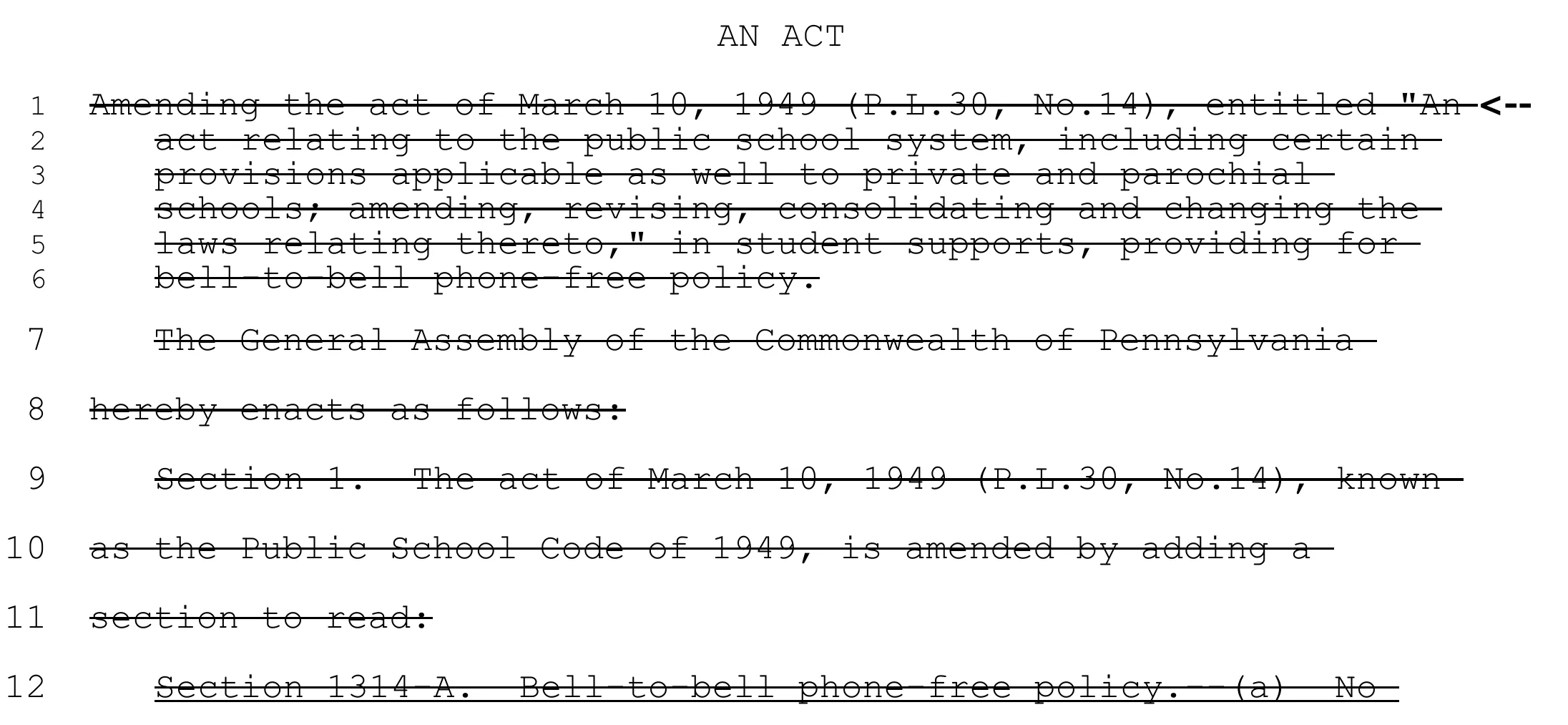
Oklahoma wrote the phrase into the rule from the first print. Pennsylvania kept it in the title and a heading, outside the rule. Arkansas gave it to the act as a name.
The 26 texts, in alphabetical order. Rule summaries are plain-language assessments made in drafting. Each quote is exact, from the text at the address given. Span means the part of the day a rule covers, and the span term is the word that sets it.

| State and text | Term that sets the span | Times found | Exact words, and what the rule says |
|---|---|---|---|
| ArkansasAct 122 of 2025 | school day | 3 in a title, name or heading | from the time students are required to be at school until the time students are dismissed from schoolDistricts and charter schools must have a policy on use during the school day, defined as required arrival to dismissal. |
| GeorgiaHB 1009, as passed House and Senate | bell-to-bell | 3 in the rule | ‘Bell-to-bell’ means the period beginning with the first bell signaling the start of instructional timeStudents may not access devices during the school day, and the school day is defined as the bell-to-bell period. |
| OklahomaHB 1276, enrolled, amending SB 139 of 2025 | bell to bell | 2 in the rule | while on the campus of a public school district from bell to bellBoards must adopt a policy barring use on campus from bell to bell, a term the law defines.Education Week’s date is the date entered, May 4, 2026. The legislature records approval on April 30, 2026. |
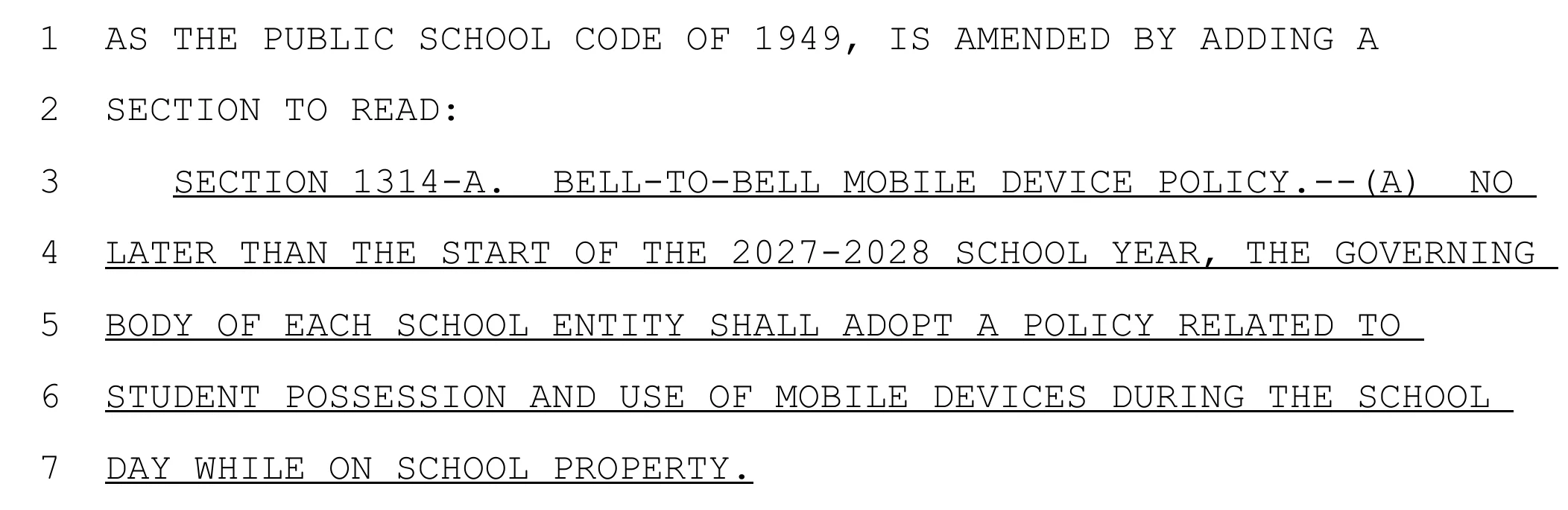
| PennsylvaniaAct 117 of 2026, SB 1014, printer’s number 1697 | school day | 2 in a title, name or heading | PROHIBIT THE USE OF A MOBILE DEVICE DURING THE SCHOOL DAY WHILE ON SCHOOL PROPERTYSchool entities must adopt a policy barring use during the school day on school property. The phrase sits in the title and a heading, outside the rule. |
| VirginiaCode of Virginia 22.1-79.3:1, current code | bell to bell | 6 in the rule | “Bell to bell” includes lunch and time in between class periods.Boards must restrict possession and bar use on school property from bell to bell, defined from first bell to dismissal, including lunch.The code text reads “dismissal bill,” which looks like a typo in the source. The current code was read in place of the 2025 and 2026 acts. |
The other 21 texts
| State and text | Term that sets the span | Times found | Exact words, and what the rule says |
|---|---|---|---|
| AlabamaHB 166, enrolled | instructional day | 0 | on the grounds thereof during the instructional dayStudents may not use a phone in a school building or on its grounds during the instructional day, and must keep it off and stored. |
| ArizonaHB 2484, Laws 2025, chapter 53 | school day | 0 | Limit the use of wireless communication devices by students during the school day.Boards must limit student use during the school day, with exceptions for teacher direction, emergencies and medical need. |
| FloridaHB 1105 of 2025, enrolled, amending section 1006.07 | school day and instructional time | 0 | elementary and middle school students may not use a wireless communications device during the school dayElementary and middle school students may not use a device during the school day. High school students may not use one during instructional time.Education Week’s table date is May 9, 2023. HB 379 of 2023 was also read, with 0 hits. Chapter 2026-80 amends other subsections and was checked. |
| IdahoIdaho Code 33-6901 and 33-6902, current code | school hours | 0 | be as limited as possible in school buildings and on school grounds or premises during school hoursBoards must adopt a policy that keeps use as limited as possible during school hours. A policy need not ban all use. |
| IllinoisPublic Act 104-0657 | school time | 0 | may allow the definition of school time to exclude a high school student’s lunch and passing periodsPolicies must at least bar use during school time, arrival to dismissal, and districts may leave high school lunch and passing periods out. |
| IndianaSB 78, enrolled | school day | 0 | stored away, powered off, and inaccessible to a student throughout the school dayPolicies must bar student use during the school day, with stated exceptions. |
| KansasHB 2299, enrolled | school day | 0 | Prohibit students from using or accessing personal electronic communication devices during the school dayBoards must adopt policies that bar use or access during the school day. |
| LouisianaSB 207 of 2024 | instructional day | 0 | no student shall possess, on his person, an electronic telecommunication device throughout the instructional dayStudents may not keep a device on their person during the instructional day. |
| MainePublic Law 2026, chapter 650 (LD 2212) | school day | 0 | for the duration of the school day, from starting bell to dismissal bellBoards must ban student use for the whole school day, named with bells but without the phrase. |
| MarylandChapter 596 of 2026 (HB 525) | academic school day | 0 | PROHIBIT A STUDENT FROM USING AN ELECTRONIC COMMUNICATION DEVICE DURING THE ACADEMIC SCHOOL DAYCounty boards must prohibit use during the academic school day, which is defined by first bell and dismissal bell. |
| MissouriSB 68 of 2025 | school day | 0 | from the beginning of the school day until the end of the school dayPolicies must bar display or use from start to end of the school day, including meals and time between classes. |
| NebraskaLB 140, slip law | on school property | 0 | while on school property or attending a school instructional functionBoards must prohibit use on school property or at school instructional functions, with exceptions. |
| New HampshireRSA 189:1-a, current statute | academic school day | 0 | from when the first bell rings to start instructional time until the dismissal bell rings to end the academic school dayPolicies must ban use from first bell to dismissal bell, with approved exceptions. |
| New JerseyS3695, third reprint | school day | 0 | an internet-enabled device on school grounds during the school dayBoards must adopt a policy, and state guidelines must bar non-academic use on school grounds during the school day.Enacted as P.L.2025, c.195. The third reprint was read in place of the public law copy. |
| New YorkS3006-C of 2025, Part C (Education Law 2803) | school day | 0 | prohibiting the use of internet-enabled devices by students during the school day anywhere on school groundsSchools must ban use during the school day anywhere on school grounds. School day is defined to include lunch, recess and passing time.Counted across S3006-C. The only bell in that budget bill is an unrelated account name. |
| North DakotaHB 1160, enrolled | instructional time | 0 | the time from the start of the school day until dismissal at the end of the school day on school premisesPhones must be locked away during instructional time, which the law defines as the whole school day, including lunch and time between classes. |
| OhioR.C. 3313.753, current code | instructional day | 0 | prohibit all cellular telephone use by students during the instructional dayPolicies must prohibit all phone use during the instructional day, with stated exceptions. |
| Rhode IslandS 0771, Substitute A (print, not the public law) | school day | 0 | a prohibition on physical access to a personal electronic device by students during the school dayPolicies must prohibit physical access to a device during the school day. |
| South CarolinaH.5100 of 2024, budget proviso 1.103, ratified version | school day | 0 | prohibits access to personal electronic communication devices by students during the school dayTo receive certain state funds, districts must carry out a policy barring access during the school day.Later budgets were not read. |
| TexasHB 1481, enrolled | school day | 0 | device while on school property during the school dayBoards must adopt a policy barring use on school property during the school day. |
| UtahSB 69 of 2026, enrolled | school hours | 0 | a student may not use a cellphone, smart watch, or emerging technology at a school during school hoursStudents may not use a phone at school during school hours, which are set by the school’s bell schedule and include lunch and transitions. |
The 5 left out of the count
- California. Not read in this pass. The state site refused the script with a 403.
- Vermont. Not read in this pass. The state site did not accept the script’s connection on three attempts.
- District of Columbia. A school system policy. Not read.
- Hawaii. A state board policy. A board draft was read and has no bell in it. The draft.
- Oregon. An executive order. Not read.
Observed
Labels and copies
Governors in Arkansas and New York used the phrase in a name and a headline. An FCC proposal in the Federal Register listed “(bell-to-bell, instructional time, etc.)” in August 2026.
One AP story on three sites and one ABC News story on eight pages count as two sources. Four states define the span in near-identical first-bell wording, as do two undated model texts. That may indicate shared model language and requires corroboration.
The 5 groups of copies
2025-01-16
We will ban cellphones in our schools, bell to bell
One Associated Press story
2026-05-21
the advisory calls for implementing bell-to-bell ban policies
2024-07-17
bell-to-bell phone-free policies
One group, a day apart
2024-08-15
Undated
from when the first bell rings ... until the dismissal bell rings
- Virginia Department of Education bulletin, September 17, 2024
- Code of Virginia 22.1-79.3:1
- Oklahoma SB 139 of 2025
- Oklahoma HB 1276 of 2026
- Maryland Chapter 596 of 2026
- New Hampshire RSA 189:1-a
Near-identical definitions in separate documents
Ten limits
The search was thin in places, and no volume measure exists. These are the limits that matter most to anyone relying on this file.
All 10 limits
- Volume went unmeasured. GDELT returned 429 on the one request made. This file holds no figure for how often the phrase ran.
- Education Week has not stated how it sorts rows or when it adopted the category.
- Ten of the 26 texts are code or a late print: Idaho, New Hampshire, Ohio and Virginia (code), and Georgia, Missouri, New Jersey, New York, Pennsylvania and Rhode Island (final or late print). A law signed and later amended may read differently.
- Still unread: the federal advisory, Virginia’s draft and final guidance, Virginia’s 2025 and 2026 acts, and the final print of Georgia HB 340.
- Outside the search: newspaper archives behind paywalls, district board minutes, social platforms, broadcast transcripts and French-language sources on Quebec.
- The search for phone uses from 2010 to 2019 is thin. Thirteen logged queries found the 2019 Texas page and a 2019 student piece and nothing earlier, and web search skews recent. Earlier uses may still exist.
- A student newspaper piece dated September 23, 2019 describes a class-time phone rule under the phrase. It stays uncited and unnamed, because its authors and many of its sources are students.
- Dated class-period uses from 2023 to 2026 were left unsearched. An AI review pass reported an October 2023 teacher podcast on that sense, and that podcast is still unread.
- Published tallies of bell-to-bell states differ. This case states no count of its own and uses Education Week’s 31 only as a list.
- Two of the 12 lines link a public archived copy, and raw copies of all 12 are kept in the case folder. Pages can change, and the 2019 page and Education Week’s table have no public archived copy.
Assessed
Other explanations
The pattern has more than one possible reading, and each of these is Not established.
The 5 other explanations
Not established
A tracker’s category name need not appear in the laws it sorts, and the row may sort by how much of the day a rule reaches.
In a keyword pass, 28 of the row’s 31 summary cards use school day, dismissal, entire or similar words, and none of the eight Instructional time cards does. The other three (Louisiana, Nebraska, Ohio) describe the instructional day or school property. A chart note speaks of “bell-to-bell restrictions” as a type of rule.
Not established
Drafters may prefer defined terms such as school day.
Georgia, Oklahoma and Virginia show the phrase can be drafted into a rule. A model bill linked under the phrase uses School Day as its term. Drafting notes are still unread.
Not established
Unconnected schools may have reached for the same plain words.
Nothing read connects Texas City, Lee and Arkansas. Victoria, Australia, announced a ban from “first bell to last bell” in June 2019. Gilbert and Seattle use an identical name, and whether they share a source is untested. The search was thin. ABC News (Australia), June 26, 2019.
Not established
The phone senses may have grown from the class-period sense.
The reported Seattle statement fits this for class-time rules. Nothing read shows the route for all-day rules. The two phone senses appear 37 days apart in 2019, and their order is unknown.
Not established
A campaign may have spread the phrase after 2024.
Fairplay and the Phone-Free Schools Movement used the phrase on July 17, 2024, before Virginia’s reported August 15 definition. More than 40 organizations signed a letter using it on March 24, 2025. An undated advocacy site says it “helped enact Texas’s bell-to-bell phone-free schools law,” and that law is worded “during the school day.” The 2019 and January 2024 uses come before every campaign use read, and that search was thin. Fairplay open letter release, March 24, 2025. Distraction-Free Schools site.
Assessed
Judgments
These are assessments of what the sources show now.
Likely
Confidence: lowEducation Week’s row works as a category of coverage, not of wording.
The summary cards and the chart note point that way. Education Week has not said so.
Likely
Confidence: lowPhone uses older than August 2019 exist in sources not searched.
Search skewed recent, and one query in an AI review pass moved the earliest date found by more than four years.
Likely
Confidence: lowThe class-period sense is still in use among educators.
The latest dated use read is December 2022, and the reported Seattle statement points the same way. No dated search for later uses was run.
Projected
The prediction that was declined
Draft, declined under the Method on November 5, 2026 and never issued.
Not product output. AI agents drafted it.
Will the Federal Register publish at least one new document containing the words bell to bell by February 3, 2027?
Error rates are not yet published.
- Why it was declined
- Its error is unmeasured, and its series and publishers are too few. The Record has the full entry.
- What it tests
- Only whether the label reaches more federal text. The five of 26 finding is outside it.
- What would change this
- A new FCC document in the E-Rate proceeding (WC Docket No. 26-133) that repeats the words. A federal notice on school phone rules from any agency. Reply comments there close November 12, 2026, and no next step in that proceeding was read.
- Next review
- February 4, 2027
Made by agents, unchecked
AI agents gathered the sources, read them, counted them and drafted this file, using scripts. No person has yet checked it or read a source. No SOVRINT software produced it. No client paid for it.
Sources, search, counting and tools
- Sources
- Twelve dated lines from 2011 to 2026 and 26 law texts, from legislatures, government sites, news outlets, advocacy groups and education bodies. Education Week’s table is used as a list only.
- Search
- 43 logged web searches for discovery, run on November 5, 2026 and listed below. Two earlier searches for 2022 and 2023 phone uses went unlogged.
- Counting
- The law counts are a regular-expression search on extracted text. Where a text with a hit could carry strikethrough, an AI agent inspected the rendered page. The Virginia executive order was read by OCR. The card keyword pass matched school day, arrival, dismissal, entire, all day, full day and bell in each card summary. No person has made these checks.
- Tools
- curl with one request per address, identified as Mozilla/5.0 (compatible; case-research/1.0), and a Chrome-style browser string in one later check. pdftotext and Tesseract for text extraction. The ERIC and Federal Register public APIs. The Gilbert page and the Federal Register dry run were first read through a web fetch tool that returns a summary. Both were then run again with curl on November 5, 2026, and the raw Gilbert page confirmed its title, date, lunch rule and passing-period rule.
- Refusals
- Refused or failed: GDELT (429), California and Vermont, LegiScan and several news sites. The last check also drew refusals from Illinois, Indiana, Pennsylvania, Utah and Fortune. Those five rest on copies kept from earlier passes.
- Snapshot
- SHA-256 of Education Week’s state table as fetched on November 5, 2026: 284f841380eafe05b5997907419963c19b5a928238170a30e9ac4fb7802092f5
- Left out of scope
- The merits of phone rules, their effects and enforcement. Students, parents and teachers as individuals. No minors are quoted.
The 43 search queries
All run on November 5, 2026. Names are withheld in one query because it points to a student newspaper piece.
- Distraction-Free Schools Model Legislation Package
- Fairplay Phone-Free Schools toolkit July 2024 "bell-to-bell" phone-free policies release
- Massachusetts conference committee bell-to-bell school cell phone ban S.2581 H.5366 November 2026
- Georgia HB 340 Distraction-Free Education Act 2025 as passed text legis.ga.gov
- Tennessee 2025 public chapter wireless communication device instructional time school SB 605 HB 932 public chapter number
- Iowa 2025 enrolled House File personal electronic devices classroom instructional time school districts policy signed Reynolds April 30 2025
- Michigan 2026 public act smartphones instructional time school districts HB 4141 signed Whitmer February 10 2026 public act number
- Delaware 2026 law cell phone policy instructional time every district charter school signed March 12 2026 Senate Bill number
- West Virginia 2025 enrolled Senate Bill 549 personal wireless communication devices county boards school day text
- Minnesota 2024 session law school district cell phone policy March 15 2025 possession and use revisor laws chapter
- Kentucky HB 208 2025 enrolled personal telecommunication device instructional time; Wisconsin 2025 Act 42 wireless communication devices instructional time; Nevada SB 444 2025
- "bell-to-bell" cell phone ban school 2023 district policy
- "bell to bell" no phones school policy 2022 students cellphones all day
- "bell to bell" teaching classroom instruction time use every minute 2025 teachers (not phones)
- "No Cell from Bell to Bell" school policy
- Yondr pouches school "bell to bell" phones locked 2023
- high school "from bell to bell" cell phones not allowed new policy 2019 OR 2021 OR 2022 OR 2023
- Virginia SB 108 2026 cell phone smart device bell to bell Acts of Assembly chapter 331 text; HB 1961 2025 chapter 606 cell phone possession school text
- "bell to bell" cell phones school policy 2015 students phones away all day
- "from bell to bell" "no cell" school district cell phone policy 2019
- "bell to bell" cell phone policy high school 2016 OR 2017 OR 2018 phones "bell to bell" principal new rule (extended)
- school handbook "bell to bell" cell phones not permitted 2012 2013 2014 student electronic devices
- "bell-to-bell" phone ban school newspaper 2018 Yondr pouches students day phones locked
- "bell to bell" cell phones school board policy 2011 phones "off and away" "bell to bell"
- district cell phone rule "bell to bell" class time only phones allowed at lunch and passing periods
- Evanston Township High School "bell to bell" phone policy lunch passing periods 2024
- Seattle Public Schools "bell to bell" cell phone policy 2026 lunch passing periods
- "bell-to-bell" instruction classroom time teachers 2022 OR 2023 maximize learning time instructional practice district
- Australia school mobile phone ban "bell to bell" 2019 2020 Victoria students first bell last bell
- "Away for the Day" campaign 2017 2018 schools phone policy "bell to bell" middle school phones lockers
- "bell to bell" cellphones school "2018-19" OR "2017-18" OR "2016-17" handbook phones off away news (extended)
- "bell to bell" phones school 2021 OR 2022 students cellphones banned high school principal "bell to bell" return to in-person
- Texas City ISD cell phone policy "bell to bell" student handbook 2019
- "bell-to-bell" instruction teachers Education Week OR ASCD OR Edutopia 2022 2023 class period time on task learning walkthroughs
- "bell to bell" teaching expectation high school turnaround plan district "instruction" 2023 superintendent classroom minutes news
- "no cell" "bell to bell" school 2017 OR 2018 cell phone policy Texas ISD new this year
- [district withheld] cell phone policy 2019 class time "bell to bell" [school withheld]
- Virginia Executive Order 33 "cell phone-free education" July 9 2024 text pdf establishing
- model legislation phone-free schools Fairplay Phone-Free Schools Movement "model bill" instructional day first bell dismissal bell Google Doc
- Evanston RoundTable ETHS "Bell to Bell" no cell phone storage classroom policy District 202 board 2024
- "bell to bell" cell phones students school rule 2010 OR 2012 OR 2013 local news principal phones "bell to bell" policy changes this year (extended)
- Georgia HB 340 2025 Distraction-Free Education Act Act number as passed text "wireless communication" legis.ga.gov
- Arizona 2025 chapter HB 2484 "wireless communication devices" Laws 2025 chapter azleg legtext laws pdf
Corrections
None so far.