File 2
The slide reported as the source of “232 times” prints no multiple
China
United States
Redrawn, not the slide
232 full icons and a half, by machine count.
The figure 232 is printed nowhere on the Office of Naval Intelligence slide reported as its source.
No Navy document that prints a multiple was found, and non-public briefings cannot be seen. In the one readable copy, an 800-pixel image, the slide shows about 232.5 ship icons under the heading “China Shipbuilding Capability,” each worth 100,000 gross tons, with no year and no source. The Navy confirmed the slide to The War Zone, whose report of July 11, 2023 is the earliest text found with the number. The figures it printed divide to 232.5: the China total over one icon.
The rest of the summary
The slide carries three marks that can be tested: the China icon total, a share of about 40 percent, and a US mark of under one icon. Together they match one year of UN records of merchant ships delivered: 2020, with China at 23,257,200 gross tons and 40.26 percent of the world, and the United States at 71,289. The China total and the share also fit 2018, and only the US mark, one small part-icon on an 800-pixel copy, separates the two. So the year is a best fit, graded Likely with Low confidence, and the test limits were set after the match was seen. The slide does not state this link, and nothing found from the Navy does. SOVRINT has not yet asked it.
In federal records the multiple began as capacity, appeared as speed by April 2024 and as a count of ships by February 2025. Of 29 lines in hearing records, bills and the Congressional Record audited in GovInfo, 7 of them from outside witnesses, none names a year for the multiple, none says gross tons and one limits it to commercial capacity. The Congressional Research Service, outside that count, has said since at least August 16, 2024 that the measure appears to relate to commercial cargo ships. GAO printed 2023 figures from the same UN source in 2025, and a 2021 commentary gave the same pair of figures for 2020. That merchant point belongs to earlier writers. What this file adds is the test against each year of the UN record.
This matters because a 230-times form of the claim now sits in text the House passed on July 22, 2026, and the Secretary of Defense used “over 230 times” in a written budget statement. Committee chairs and ranking members in both chambers have used a form of it, as have a paper by two senators and two representatives and a letter from 68 lawmakers. The file does not say the number is false. In the UN record of merchant ships delivered, China built 23.3 million gross tons in 2020 and 41.6 million in 2025, against 71,289 and 25,172 for the United States. A reader of those federal documents cannot tell from the sentence what was measured.
- Status
- Draft
- Dated
- November 6, 2026
- Retrieved
- November 6, 2026
- Responsible
- SOVRINT Inc.
- Corrections
- None
- The claim
- Unverified
AI agents gathered the sources, read them, counted them and drafted this file, using scripts. No person has yet checked it or read a source. No SOVRINT software produced it.
What this file does not say
The claim: unverified
China has 232 times the shipbuilding capacity of the United States.
The claim appears in the texts, and no primary record stating this multiple, for or against, has been located. The slide draws two blocks and prints no multiple.
- This file does not say the number is false. True and false are left to fact-checkers.
- It does not say China’s lead is small. In the UN record of merchant ships delivered, China built 23.3 million gross tons in 2020 and 41.6 million in 2025, against 71,289 and 25,172 for the United States. Divided, those figures run from 64 to 176 for 2014 to 2019 and from 326 to 1,652 for 2020 to 2025, and no year comes to 232. UNCTAD prints no ratio, in recent years the US figure is small enough for one ship to move the result by hundreds, and 2025 has no printed table.
- It does not say the United States has no shipbuilding problem, or that commercial yards have no bearing on naval strength. The slide itself prints “PLAN surface ship producers are mixed military/commercial” and “China is the world’s leading shipbuilder by a large margin.” Warships sit outside the UN record, so that record says nothing about them either way.
- It does not say what China’s yards could build, and it offers no warship multiple.
- It does not prove the UN link. The slide matches a UN series. The slide prints no source in the one readable copy, and no public Navy text names one. SOVRINT has not yet asked.
- It argues no policy. It takes no side on any bill, budget, fee or trade action.
- It does not say the number informed the Section 301 action, or that any bill or budget rests on it. Nothing read shows either. USTR’s own report and notices do not use it.
- It says nothing about why anyone used the number.
- It makes no prediction.
Observed for the printed text. Assessed for the counts and measures.
The block on the slide
The block at the head of this file is a redrawing by SOVRINT, not the slide. It sets down the count of the block on the slide reported as the source, and that count is a machine count: 15 rows of 15 (225), then 7 full icons and one part icon.
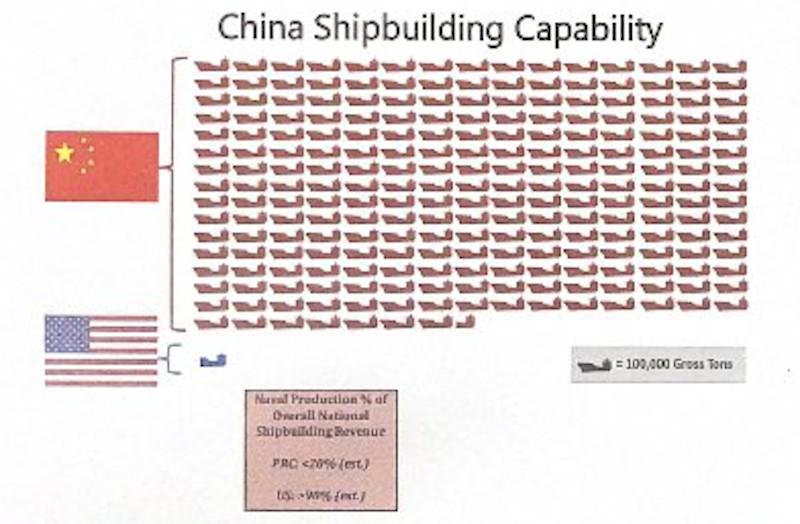


What is printed
- Block headingChina Shipbuilding Capability
- Right text panelControls ~40% of global commercial shipbuilding market (US: < 0.5%)
- Right text panel, headingChina is the world’s leading shipbuilder by a large margin
- Left text panel, headingPLAN surface ship producers are mixed military/commercial
- MarkingUNCLASSIFIED, top right
- The keyOne icon = 100,000 Gross Tons
What is not printed
- 232, 230 or 200 as a multiple
- 23,250,000 or any other total
- Any year on the tonnage block
- Any time unit on the tonnage block, such as per year
- A count of ships on the tonnage block
- Any source line, in the one readable copy
- The word capacity, anywhere on the slide
Observed
Twenty-two lines
The multiple runs in three number forms, 232, 230 and 200, on the axis. The two heading words mark where the word changed. The nouns beside the number are recorded per line.
- China Shipbuilding CapabilityOffice of Naval Intelligence, slide marked UNCLASSIFIED, page 9, as reproduced by The War Zone
- at least an astonishing 232 times greaterThe War Zone, news report, 1:25 pm EDT
- The slide provides context and trends on China’s shipbuilding capacity. It is not intended as a deep-dive into the PRC [People’s Republic of China’s] commercial shipbuilding industry.Navy spokesperson, statement to The War Zone
- A recent memo from the Office of Naval Intelligence suggests that China’s shipbuilding capacity is more than 230 times larger than our own.Ranking Member, Senate Armed Services Committee, S. Hrg. 118-796, p. 3
- Specifically said they are able to produce--handle a capacity around 200--or 23.2 million tons compared to the U.S. of about 100,000 tons, which is about a 232 times greater capacity to build and maintenance their fleet.Senator on the Armed Services Committee, S. Hrg. 118-796, p. 28
- capacity to build PLA combat ships at 200 times the rateBusiness Insider, headline, on Yahoo News
- fields 232 times the shipbuilding capacity of the United StatesCenter for International Maritime Security, commentary in a personal capacity
- the Naval Intelligence that was just declassified looking at the shipbuilding of China saying they can ship build 232 times faster than we can.Ranking Member, Senate Appropriations Homeland Security subcommittee, S. Hrg. 118-587, p. 37
- Meanwhile, our strategic competitor, the People’s Republic of China, became the world’s top shipbuilding and shipping nation, boasting 230 times more shipbuilding capacity than the United States, according to the Office of Naval Intelligence.Congressional Guidance for a National Maritime Strategy, by two senators and two representatives, p. 1 (PDF p. 2)
- Recent estimates indicate that China’s current capacity is about 200 times the United States’ capacity for shipbuilding, and its military and commercial fleets are rapidly expanding.Member, also on the Select Committee on China, House Transportation and Infrastructure subcommittee, Serial No. 118-55, p. 31
- The Office of Naval Intelligence estimates that China shipyards have 232 times the production capacity of our domestic capacity.Witness for a petitioner union, US Trade Representative’s Section 301 hearing, p. 28
- China has about 230 times as much shipbuilding capacity as the United States when measured in terms of gross tons of ships that can be produced per unit of time.Congressional Research Service, RL33153, version printed August 16, 2024, p. 59
- According to the Office of Naval Intelligence, the People’s Republic of China became the world’s top shipbuilding and shipping nation, boasting 230 times more shipbuilding capacity than the United States.H.R. 10493, SHIPS for America Act of 2024, sec. 2(10), a finding
- Also, if you look at their total production capacity, they can build 232 ships for every one ship that we build.Vice Chair, House Armed Services Committee, H.A.S.C. No. 119-2, p. 16
- As a result, the U.S. Navy estimates China’s shipbuilding capacity at roughly 232 times that of the United StatesCongressional Labor Caucus, letter to the US Trade Representative
- 23.25 million tons, which is 232 times that of the USYicai Global, opinion column (China)
- can build 200 times our rateVice Chief of Naval Operations, at a think tank panel, as reported by USNI News
- China has over 230 times the shipbuilding capacity of the U.S.Secretary of Defense, written statement on the fiscal 2026 budget, Senate Appropriations Defense Subcommittee
- China’s shipbuilding capacity is estimated to be 232 times that of the United States, with a merchant fleet of 7,838 vessels vs. 185 US-flagged vessels.Company witness, prepared statement, Senate Commerce subcommittee, S. Hrg. 119-300, p. 34
- China’s commercial shipbuilding capacity now exceeds U.S. capacity by a factor of more than 200 to 1.Industry alliance, prepared statement, Senate Commerce subcommittee, S. Hrg. 119-300, p. 57
- For example, Chinese shipbuilders build 230 times the number of ships per year as the United States.Trade association witness, House Judiciary subcommittee, Serial No. 119-59, p. 56
- Today, China surpasses the U.S. Navy in the total number of warships in their fleet, and its shipbuilding capacity is estimated to be over 200 times greater.Chair, House Appropriations Defense Subcommittee, remarks posted for the Navy and Marine Corps budget hearing
The 22 lines are chosen examples with no sampling frame. They show no rate and no order of adoption. Each quoted line is Observed: the wording was on the page when read for this file on or before November 6, 2026, whether or not any claim inside it is correct. News and commentary lines are short fragments. Government text is exact. A carries mark is true only when the text applies that thing to the multiple itself, in the quoted sentence, a sentence beside it or a footnote on it: a unit of any kind, a named data year, a merchant or commercial limit on the figure, or a source for the number. A thing stated nearby about other facts does not count, and the line’s note says so where it matters. Carries year means a named data year, so words like today or per year do not count. The slide line and the Navy spokesperson line state no multiple, so their marks describe what they say about the block or the slide. Level federal means a government office or a member of Congress. Level witness means an outside witness or statement in a federal or USTR record.
- Lines above
- 22, chosen
- They carry
- unit 8, year 0, merchant 2, source 13
- GovInfo lines
- 29, in 26 items
- By number
- 232: 11, 230: 11, 200: 7
- By claim
- capacity 21, speed 6, ships 2
- Of those 29
- year 0, gross tons 0, commercial 1
Observed for the figures. Assessed for the match.
Twelve years of the UN record
In this record the merchant gap is wider in later years: China delivered 41.6 million gross tons in 2025, against 25,172 for the United States.
| Year | China, gross tons | China, As icons | Share of world | Marks passed | US, gross tons | US, As icons | China over US, computed |
|---|---|---|---|---|---|---|---|
| Slide | not printed | about 232.5 | about 40% | The three marks | not printed | about 0.7 to 0.8 | not printed |
| 2014 | 22,851,302 | 228.51 | 35.89% | none | 212,113 | 2.12 | 108 |
| 2015 | 25,275,424 | 252.75 | 37.24% | none | 355,067 | 3.55 | 71 |
| 2016 | 22,365,449 | 223.65 | 33.49% | none | 351,092 | 3.51 | 64 |
| 2017 | 23,682,160 | 236.82 | 36.04% | none | 225,593 | 2.26 | 105 |
| 2018 | 23,259,789 | 232.60 | 40.07% | icons, share | 201,678 | 2.02 | 115 |
| 2019 | 23,074,209 | 230.74 | 35.01% | none | 131,415 | 1.31 | 176 |
| 2020 | 23,257,200 | 232.57 | 40.26% | icons, share, US | 71,289 | 0.71 | 326 |
| 2021 | 26,863,204 | 268.63 | 44.20% | none | 32,343 | 0.32 | 831 |
| 2022 | 25,893,611 | 258.94 | 46.59% | US | 72,679 | 0.73 | 356 |
| 2023 | 32,859,862 | 328.60 | 50.73% | US | 64,809 | 0.65 | 507 |
| 2024 | 39,118,358 | 391.18 | 54.57% | none | 30,782 | 0.31 | 1,271 |
| 2025 | 41,595,055 | 415.95 | 53.82% | none | 25,172 | 0.25 | 1,652 |
Assessed
The three marks are the China icon total, the share of about 40 percent, and the US mark of under one icon. Together they match one year of this series, 2020: China 23,257,200 gross tons, or 232.57 icons; 40.26 percent of world deliveries; and the United States 71,289 gross tons, or 0.71 of an icon. The China total and the share also fit 2018, and only the US mark separates the two. The slide prints no year and no source, nothing found from the Navy states the link, and SOVRINT has not yet asked. The file says matches. Asking the Navy or the Office of Naval Intelligence would settle it.
How firm the match is
- By arithmetic: the block’s total matches the size of one year of Chinese merchant deliveries. Only 2018 and 2020, of twelve years, fall within 1 icon. Deliveries ran 22.4 to 25.3 million gross tons every year from 2014 to 2020, so any capacity figure of that era would sit near this range.
- Best fit and not proven: 2020 as the single year. Only the US mark separates it from 2018. 71,289 gross tons is 0.71 of an icon, inside the measured 0.7 to 0.8, and 2022’s 0.73 is inside it too. 2018 fails because its figure is two icons and the mark is under one.
- 2018 survives if the US mark came from a different source.
- The Navy’s words are commercially-available shipbuilding data, so the panel could come straight from Clarksons, which is UNCTAD’s own source. So this file says it matches the UNCTAD record, which is based on Clarksons.
The year test, year by year
China within 1 icon of the measured total, share rounds to 40, US mark within 0.15 of an icon. These limits were set after the 2020 match had been seen, so this is a check of a known fit and not a blind test.
- 2020
- 3 of 3
- 232.57 icons, 40.26 percent, 0.71 icon
- 2018
- 2 of 3
- 232.60 icons and 40.07 percent pass. The US mark fails at 2.02 icons, more than a full icon too many.
- 2021
- 0 of 3
- 268.63 icons, 44.20 percent, 0.32 icon. All three fail.
- 2022 and 2023
- 1 of 3
- Only the US mark passes.
- 2014 to 2017, 2019, 2024, 2025
- 0 of 3
- None pass.
- Averages 2018 to 2020, 2016 to 2020, 2014 to 2020
- 0 or 1 of 3
- Each fails on share and on the US mark. The 2018 to 2020 average passes on the China total alone.
- The text “US: < 0.5%” does not separate years. It fits every year except 2015 and 2016.
- Under looser limits, China within 5 icons and the share rounded to the nearest ten, 2014, 2017, 2018, 2019 and 2020 pass those two marks. Only 2020 to 2025 have a US figure under one icon, so 2020 is still the one year left.
- The share does not select the year. Rounded to the nearest ten, about 40 percent fits every year from 2014 to 2021 except 2016, and it also fits 37.5 percent in compensated gross tons and about 43 percent in deadweight tons. World output was near 58 million gross tons in both 2018 and 2020, so the China total and the share are not independent marks there.
Observed
UNCTAD publishes no ratio. The ratio column is China divided by the United States, computed for this file. It runs from 64 to 176 for 2014 to 2019 and from 326 to 1,652 for 2020 to 2025, so 232 is not the UN ratio for any year. In recent years the US figure is so small that one ship moves the result by hundreds: a single 10,000 gross ton ship added to 2025 would take 1,652 to about 1,183. 2025 has no printed table.
UNCTADstat bulk file. Review of Maritime Transport 2021, table 2.7, printed p. 39, PDF p. 65. UNCTADstat, “Ship building: Merchant fleet built - Annual (analytical)”, bulk file with file time 2026-06-11, fetched 2026-11-06, with the matching tables in the Review of Maritime Transport. The printed Reviews and the file differ in five years: 2015, 2016, 2017, 2022 and 2023. For 2015 the printed figure is about 23.14 million against 25.28 million in the file. 2018 and 2020 agree apart from rounding, so the year test does not depend on this. Download the table as CSV.
What the series counts and leaves out
- Propelled seagoing merchant vessels of 100 gross tons and above, counted in the year of delivery and credited to the economy that built them. Bulk carriers were 64.7 percent of China’s 2020 figure.
- Gross tonnage is a measure of size from enclosed volume, set by the 1969 Tonnage Convention. It is not a weight. One 100,000 gross ton icon is about 322,000 cubic metres of enclosed space, by this file’s arithmetic.
- A delivery year counts ships finished that year. It reflects orders placed years earlier. The series holds deliveries and no measure of what yards could build if full. UNCTAD’s 2025 Review says assessing shipyards and their capacity depends on wide-ranging factors. The same section prints that 120 active Chinese yards account for around 45 percent of global yard capacity and, citing BRS Group, that total capacity is projected to rise to 1,700 ships per year. It gives no US figure and no China-to-US capacity ratio in gross tons.
Left out
- Military vessels. UNCTAD’s definition excludes them and the Tonnage Convention does not apply to ships of war, so warships built in either country add nothing to this series.
- Inland waterway vessels, fishing vessels, yachts and most offshore units. USTR says US yards delivered 608 vessels of all types in 2020, mostly inland barges and tugs and towboats, which is a wider scope than this series. No matching all-types count for China was read.
- Navy tonnage is normally displacement, a weight. The slide’s second chart prints tons with no type. Assessed: it is likely displacement, which would be a different unit from the icons.
- UNCTAD itself calls delivered tonnage new capacity in its 2023 and 2024 Reviews, and BRS Group files deliveries under a shipbuilding capacity heading. There the word means the size of ships added. Whether the word slid the same way for the Office of Naval Intelligence is not shown.
- Public figures put Chinese deliveries above the block’s total in other years: 40.9 million in 2011 in the USTR report and 41.6 million in 2025 in this series. So the block is not the highest figure on record.
Other measures, for scale
These are different measures, shown for scale. None corrects 232, and none counts warships.
- 2018 to 2022 pooled, gross tons: 122,348,013 against 509,404, about 240 to 1. This file’s arithmetic; no source prints it.
- 2018 to 2022, compensated gross tons, Clarksons data via the OECD: 64.4 million against 0.74 million, about 87 to 1.
- 2023 in GAO-25-107304, footnote 2, from the same UN source: about 33 million tons against about 65,000 tons. GAO states no ratio.
- China’s 2020 share by unit: gross tons 40.26 percent, compensated gross tons 37.5 percent (OECD), deadweight tons about 43 percent (BRS Group; China’s ministry as reported by CGTN). About 40 percent fits gross tons.
- Share of global yard capacity in the Review of Maritime Transport 2025: around 45 percent for China’s 120 active yards. No US figure is given.
- Existing archived copies of the UNCTADstat file (captures of 2021-05-01, 2022-05-12 and 2023-03-18) agree with the 2026 file to the ton on all 21 year rows. The file stamped 2021-06-01 stops at 2020 and was still live on 2022-05-12, so 2020 was UNCTADstat’s latest year for about a year. That may explain why 2021 does not fit, since the Navy ties PB23 to its shipbuilding plans and says the slide was iterated. Clarksons subscribers would have had 2021 figures earlier, so this is an explanation that fits and no more.
- A text search for 232 or 230 times found no hit for the multiple in the Reviews of Maritime Transport 2015 to 2025, the USTR report, the CSIS Ship Wars report, or the Japanese, JSEA and BRS sources. The OECD reports were read in part and not run through that search.
Observed
How the wording moved
These rows order dated sightings. Each date is the earliest found for that wording. They do not show who copied whom, and they are not a chain of transmission.
Capability becomes capacity
From “China Shipbuilding Capability” on the slide
To “shipbuilding capacity”
The first sighting, and 1 more
Construction capacity
Sino Defence Forum, post 5,992
A forum member’s reading of the image, and the earliest use of the word found. The earliest official use found came nine days later, in the reply below. Who used the word first in that exchange is Not established.
China’s shipbuilding capacity
Navy spokesperson, statement to The War Zone (archived copy)
In the same article as The War Zone’s own use.
Icons become a multiple
From About 232.5 icons of 100,000 gross tons
To “232 times greater”
The first sighting
at least an astonishing 232 times greater
Earliest found. The route through the icons is Assessed.
Gross tons of ships become warships
From Gross tons, with no ship type on the block
To “surface warships and submarines”
The first sighting, and 1 more
more capable of producing surface warships and submarines
The War Zone, lede (archived copy)
This is in the first report, so it is a starting point. The same article’s body says gross tonnage.
200 times the Navy shipbuilding capacity
Ranking Member, Senate Armed Services Committee, radio interview transcript on a Senate office site (archived copy)
The closest federal wording to warships found, off the GovInfo set. The source returned 403, so it was read in an existing archived copy.
Gross tons become tons, then no unit
From Gross tons
To “tons”, then nothing
The first sighting, and 2 more
less than 100,000 tons
Tons stands in the sentence after the words gross tonnage, so this is the first report’s own shortening. Of 29 GovInfo lines, one gives tons and none gives gross tons.
about 23.2 million tons
Fox News Digital, 8:00 am EDT, and the Senate Armed Services Committee the same day
First found with the 23.2 million rounding. The word gross does not appear on the Fox page.
The Navy’s caveat does not travel
From The slide is “not intended as a deep-dive” into China’s commercial shipbuilding industry
To No such wording in the 26 audited GovInfo items
The first sighting, and 2 more
not intended as a deep-dive
Navy spokesperson, statement to The War Zone (archived copy)
A text search of all 26 audited GovInfo items finds the Navy’s wording in none of them. CRS made a related merchant point in 2024 in its own words.
not intended as a deep-dive
not intended as a deep-dive
Source labels run side by side
From A slide with no source line
To The slide, ONI, a memo, a document, estimates, the Navy and no source at all
The first sighting, and 13 more
A U.S. Navy briefing slide
Each row is the earliest date found for that label. The labels do not form a sequence: a use with no source came five days after the memo line, and the Secretary of Defense’s statement of June 2025 also names none. The same article says the data was compiled by the Office of Naval Intelligence.
Navy intelligence says
A recent memo from the Office of Naval Intelligence
sensitive but not classified document
Senator on the Armed Services Committee, S. Hrg. 118-796, p. 28
a shipbuilding capacity more than 200 times, with no source
recently assessed
recent estimates suggest
according to the Office of Naval Intelligence
Congressional Guidance for a National Maritime Strategy (archived copy)
The Office of Naval Intelligence recently said
Member of a House Financial Services subcommittee, Serial No. 118-91, p. 25
Office of Naval Intelligence estimates
The U.S. Navy estimates
the U.S. Navy estimates
Letter from 68 lawmakers, on a House member’s site
Earliest federal text found with this label.
estimated to be 232 times, footnoted to The War Zone
“At least” is dropped
From “at least” 232
To “about 232” and a flat 232, side by side within a day
The first sighting, and 1 more
232 Mal größere Kapazität
Futurezone, metadata time 13:05 UTC
Earliest timestamp found with no floor. theTrumpet.com and Guancha also carried 232 with no floor that day, and the order within the day is not firm. The trade group witness kept “at least 232 times” at the USTR hearing of March 24, 2025.
about 232 times more
232 is rounded to 230
From 232
To “more than 230 times”
The first sighting
more than 230 times larger than our own
Ranking Member, Senate Armed Services Committee, S. Hrg. 118-796, p. 3
The 232, 230 and 200 forms then run side by side: 11, 11 and 7 of the 29 GovInfo lines.
Capacity becomes a rate, then speed
From A tonnage total
To “the rate”, “faster”, “the speed”
The first sighting, and 5 more
produce ships at a faster rate
Fox News Digital, opening sentence
First rate framing found, with no multiple in that sentence. The same page gives 232 as capacity.
at 200 times the rate
First headline found with a multiple stated as a rate. Its body credits Fox News Digital for the Navy’s confirmation.
200 times faster
Al Mayadeen English, headline (archived copy)
Direct request returned 403. Read in an existing archived copy.
232 times the speed of America
200 times our rate
Vice Chief of Naval Operations, as reported by USNI News (archived copy)
The only use found from a serving Navy officer. Direct request returned 403. Read in an existing archived capture.
An undated figure takes the present tense
From No year on the block
To “now”, “Today”, “current”, “In 2024”
The first sighting, and 1 more
is now more than 230 times
Ranking Member, Senate Armed Services Committee, S. Hrg. 118-658, p. 3
None of the 29 GovInfo lines names a data year. A House letter reported on March 17, 2025 says “In 2024”; the letter itself was not read.
In 2024, China was estimated
Federal lawmakers’ letter, quoted by the Portland Press Herald
Read only as quoted in the news report.
A merchant reading of the figure enters federal text, and the multiple keeps going
From No merchant reading of the 230 or 232 figure found in federal text
To CRS: the measure appears to relate primarily to commercial cargo ships
The first sighting, and 1 more
appears to relate primarily to capacity for building relatively less complex commercial cargo ships
Congressional Research Service, RL33153, p. 59
The first federal text found to apply a merchant reading to the 230 or 232 figure itself. Absent from the version of January 30, 2024. In the version printed April 24, 2025 the word primarily is gone and “and unarmed” is added. 15 of the 26 GovInfo items are dated after this version, and one line among them carries a merchant limit.
China built 26 million tons of -- of commercial shipping last year
Witness, US-China Economic and Security Review Commission hearing, transcript p. 128
An earlier federal comparison of commercial tonnage, with the year 2022 named and “hundreds of times” in place of 230 or 232, so it is not among the 29 lines. The Navy’s own statement of 2023-07-11 also used the word commercial.
A time unit appears
From No time unit on the slide
To “per unit of time”, “annual”, “per year”
The first sighting, and 2 more
per unit of time
Congressional Research Service, RL33153, p. 59
The slide prints no period. The UN series the block matches is annual, so these words add something the slide leaves out.
annual shipbuilding capacity
the number of ships per year
A count of ships appears
From Gross tons
To “232 ships for every one ship” in one remark, then one witness statement
The first sighting
232 ships for every one ship
Vice Chair, House Armed Services Committee, H.A.S.C. No. 119-2, p. 16
The same member said capacity in that sentence and “232 times the shipbuilding capacity” two weeks later.
The 230 sentence reaches House-passed text
From A finding in an introduced bill
To Sec. 3602(10) of the defense authorization bill the House passed
The first sighting
boasting 230 times more shipbuilding capacity
H.R. 8800, engrossed in House, sec. 3602(10)
The sentence came in through amendment 313 in en bloc No. 5, agreed by voice vote. It keeps the attribution to the Office of Naval Intelligence. No public ONI text with a multiple was found.
Observed for the counts. Assessed for what they can show.
The series
The written search, Query B
("232 times" OR "230 times" OR "200 times" OR 232x OR 230x) AND (shipbuilding OR shipyards) AND China AND publishdate:range(2023-07-01,2026-11-06)
Query B meets rule 1.2 as written. It is one written search of one named source, counted in items per calendar week, with copies folded. It is a thin series: 15 items in 13 of 175 weeks, and it misses 11 of the 26 items the audit found. The 26-item audited set does not meet rule 1.2 as it stands, because it came from several searches and a scan and not from one written search. It is shown beside the series as an audit of it.
2023
2024
2025
2026
Items the written search found, one mark per item
Audited items it missed
2023-07-01 to 2026-11-06, which is 175 calendar weeks by Monday date (2023-07-03 to 2026-11-02)
How the search was counted
B (the series), GovInfo (govinfo.gov), public search page, November 6, 2026. 19 records, 17 true documents, 15 items. 2 false records: a House DHS appropriations hearing where 200 times concerns information passed to social media firms, and a Texas ship-collision opinion read from its teaser only. 3 bill texts fold to 1.
Distinct items per calendar week. An item is one published text, a hearing record is one item, and copies are folded first. Items sit in the week they were held or first printed. Folding puts the July 2026 bill copies in the December 2024 item, so that week shows no new item.
- Query B
- 15 items, 13 weeks, peak 2
- Audited set
- 26 items, 22 weeks, peak 2
- Audited, by year
- 2023: 4, 2024: 9, 2025: 12, 2026: 1
Too few to read
Rule 1.5 applied to the last 12 full weeks against the 12 before: 0 and 0 in both counts, so Too few to read (floor 24). The last 52 full weeks against the 52 before: 2 and 12 audited, 0 and 6 for Query B. Both are under the floor of 104, so no percentage is given.
Neither count is a trend under rule 1.3, and no rise or fall is claimed.
What it can show
- From Query B: the multiple was in the federal record by 2023-09-14.
- From the audited set: it recurs across at least 10 committees or subcommittees and both floors.
- From the audited set: it was still in use in 2026.
- From the audited set: its noun changed, with dates. All 15 Query B items are capacity lines, so Query B alone cannot show this.
- From Query B with copies folded: it reached House-passed text, as a copy of an item counted in 2024.
What it cannot show
- A rise, a fall or a peak.
- Who copied whom, except where a footnote says so.
- How many people heard it.
- A complete count of 2025 and 2026. Hearings post months late, and no 2026 Senate Armed Services hearing turned up in GovInfo.
Federal Register searches for the multiple returned 0 records.
Known misses
Query B found 15 of the 26 audited items, so its recall is at most about 58 percent, because the audited set is itself incomplete. It returned 3 of the 7 copies of the bill sentence.
- H.A.S.C. No. 118-46 (200X)
- S. Hrg. 118-587 (232 times faster)
- 170 Cong. Rec. S6327 (no shipbuilding word in the granule)
- H.A.S.C. No. 119-2 (232 ships)
- S. Hrg. 119-136 (232 times the speed)
- S. Hrg. 119-269 (230 times faster)
- S. Hrg. 119-355
- S. Hrg. 119-283
- S. Hrg. 119-300 (two lines)
- S. Hrg. 119-423
- Serial No. 119-59
Copies of the bill sentence it missed
- S. 1541
- H. Rept. 119-755, amendment 313
- 172 Cong. Rec. H5086
- H.R. 8800 EH
Six of the 11 fall outside the query’s terms: 200X, 232 ships, and four documents with no word shipbuilding or shipyards (170 Cong. Rec. S6327, S. Hrg. 119-355, 119-283 and 119-423). The other five hold terms the query should have matched, and why they were missed is not known. Six exact phrases copied from open documents returned 0 records, so the phrase search is unreliable here. A repeatable job needs a full-text scan step.
The audit, and how Query B was run
- The audited set came from written term searches, then a scan of the full text of 1,191 fetched GovInfo files (869 hearing HTML files, 206 Congressional Record granules, plus reports, prints, GOVPUB PDFs and bills), then opening each hit. The widest hearing pass added 681 hearings and 1 new item.
- Method 1.2: distinct items per calendar week, from a written search of one named public source, with copies folded first.
- The searches ran in the public search page, not the API. The one API try with a demo key returned 429 and was not retried. After the first two searches, the page’s own search request was issued from inside the page with 2.5 second pauses. A free API key is needed for a repeatable job.
- Under rule 1.1 two texts carry one narrative when they make the same claim about the same subject. Of the 29 GovInfo lines, 21 say capacity and are same-claim lines. The 6 speed lines and 2 ship-count lines make a changed claim in plain terms, so they sit outside the narrative as rule 1.1 defines it and are reported beside the count as changed-claim lines. Of the 26 audited items, 18 hold a same-claim line and 8 hold changed-claim lines only. Query B is unaffected, as all 15 of its items are capacity lines.
The other 4 written searches
A
("232 times" OR "230 times") AND shipbuilding AND publishdate:range(2023-07-01,2026-11-06)
13 records, 13 true documents. Copies not folded for this query.
C
"232 times" AND publishdate:range(2023-07-01,2026-11-06)
6 records, 6 true documents.
D
"230 times" AND publishdate:range(2023-07-01,2026-11-06)
13 records, 11 true documents. 2 false: a patent opinion read from its teaser only, and Serial 119-32 on aviation accident rates.
Federal Register
"232 times"; "230 times"; "times the shipbuilding capacity"; "times more shipbuilding capacity"
0 records, 0 true documents. federalregister.gov API. 0 for each phrase. “shipbuilding capacity” alone returns 12 and none carries the ratio. The two plain multiples were rerun for this draft and still return 0.
The 22 weeks with an item
| Week of | Query B | Audited | Documents |
|---|---|---|---|
| 2023-09-11 | 1 | 1 | S. Hrg. 118-796 |
| 2023-09-18 | 1 | 1 | 169 Cong. Rec. S4568 |
| 2023-10-16 | 1 | 1 | S. Hrg. 118-658 |
| 2023-11-13 | 0 | 1 | H.A.S.C. No. 118-46 |
| 2024-03-11 | 1 | 1 | Serial No. 118-80 |
| 2024-04-08 | 0 | 1 | S. Hrg. 118-587 |
| 2024-04-15 | 1 | 1 | S. Hrg. 118-482 |
| 2024-04-29 | 2 | 2 | Congressional Guidance for a National Maritime Strategy; Serial No. 118-55 |
| 2024-05-06 | 1 | 1 | Serial No. 118-91 |
| 2024-05-13 | 1 | 1 | 170 Cong. Rec. H3170 |
| 2024-09-23 | 0 | 1 | 170 Cong. Rec. S6327 |
| 2024-12-16 | 1 | 1 | H.R. 10493, SHIPS for America Act of 2024, sec. 2(10) |
| 2025-02-03 | 1 | 1 | Serial No. 119-4 |
| 2025-02-10 | 0 | 2 | H.A.S.C. No. 119-2; S. Hrg. 119-136 |
| 2025-02-24 | 2 | 2 | Serial No. 119-5; H.A.S.C. No. 119-3 |
| 2025-03-03 | 1 | 1 | S. Hrg. 119-298 |
| 2025-04-07 | 1 | 2 | S. Hrg. 119-269; H.A.S.C. No. 119-11 |
| 2025-07-21 | 0 | 1 | S. Hrg. 119-355 |
| 2025-09-01 | 0 | 1 | S. Hrg. 119-283 |
| 2025-10-27 | 0 | 1 | S. Hrg. 119-300 |
| 2025-12-01 | 0 | 1 | S. Hrg. 119-423 |
| 2026-03-16 | 0 | 1 | Serial No. 119-59 |
Every week not listed is 0.
Observed
The lines in full
Earliest observed source does not establish original authorship.
Undated
China Shipbuilding Capability
Office of Naval Intelligence, slide marked UNCLASSIFIED, page 9, as reproduced by The War Zone (archived copy)
- Unit
- yes
- Year
- no
- Merchant
- no
- Source
- no
Source given: none
at least an astonishing 232 times greater
The War Zone, news report, 1:25 pm EDT (archived copy). See also Archived capture of January 27, 2024
- Unit
- yes
- Year
- no
- Merchant
- no
- Source
- yes
Source given: a U.S. Navy briefing slide
The slide provides context and trends on China’s shipbuilding capacity. It is not intended as a deep-dive into the PRC [People’s Republic of China’s] commercial shipbuilding industry.
Navy spokesperson, statement to The War Zone (archived copy)
- Unit
- no
- Year
- no
- Merchant
- no
- Source
- yes
Source given: multiple public sources
A recent memo from the Office of Naval Intelligence suggests that China’s shipbuilding capacity is more than 230 times larger than our own.
Ranking Member, Senate Armed Services Committee, S. Hrg. 118-796, p. 3
- Unit
- no
- Year
- no
- Merchant
- no
- Source
- yes
Source given: a recent memo from the Office of Naval Intelligence
Specifically said they are able to produce--handle a capacity around 200--or 23.2 million tons compared to the U.S. of about 100,000 tons, which is about a 232 times greater capacity to build and maintenance their fleet.
Senator on the Armed Services Committee, S. Hrg. 118-796, p. 28
- Unit
- yes
- Year
- no
- Merchant
- no
- Source
- yes
Source given: a document obtained by one of our news agencies
capacity to build PLA combat ships at 200 times the rate
Business Insider, headline, on Yahoo News (archived copy)
- Unit
- no
- Year
- no
- Merchant
- no
- Source
- yes
Source given: leaked US Navy intelligence
fields 232 times the shipbuilding capacity of the United States
Center for International Maritime Security, commentary in a personal capacity (archived copy)
- Unit
- no
- Year
- no
- Merchant
- no
- Source
- yes
Source given: the Office of Naval Intelligence, “recently assessed”
the Naval Intelligence that was just declassified looking at the shipbuilding of China saying they can ship build 232 times faster than we can.
Ranking Member, Senate Appropriations Homeland Security subcommittee, S. Hrg. 118-587, p. 37 (archived copy)
- Unit
- no
- Year
- no
- Merchant
- no
- Source
- yes
Source given: Naval Intelligence, “just declassified”
Meanwhile, our strategic competitor, the People’s Republic of China, became the world’s top shipbuilding and shipping nation, boasting 230 times more shipbuilding capacity than the United States, according to the Office of Naval Intelligence.
Congressional Guidance for a National Maritime Strategy, by two senators and two representatives, p. 1 (PDF p. 2) (archived copy)
- Unit
- no
- Year
- no
- Merchant
- no
- Source
- yes
Source given: the Office of Naval Intelligence
Recent estimates indicate that China’s current capacity is about 200 times the United States’ capacity for shipbuilding, and its military and commercial fleets are rapidly expanding.
- Unit
- no
- Year
- no
- Merchant
- no
- Source
- no
Source given: recent estimates, no source named
The Office of Naval Intelligence estimates that China shipyards have 232 times the production capacity of our domestic capacity.
Witness for a petitioner union, US Trade Representative’s Section 301 hearing, p. 28
- Unit
- no
- Year
- no
- Merchant
- no
- Source
- yes
Source given: Office of Naval Intelligence estimates
China has about 230 times as much shipbuilding capacity as the United States when measured in terms of gross tons of ships that can be produced per unit of time.
Congressional Research Service, RL33153, version printed August 16, 2024, p. 59 (archived copy). See also Congress.gov PDF, version 279
- Unit
- yes
- Year
- no
- Merchant
- yes
- Source
- yes
Source given: an unclassified U.S. Navy briefing slide
According to the Office of Naval Intelligence, the People’s Republic of China became the world’s top shipbuilding and shipping nation, boasting 230 times more shipbuilding capacity than the United States.
H.R. 10493, SHIPS for America Act of 2024, sec. 2(10), a finding. See also H.R. 8800, engrossed in House, sec. 3602(10), July 22, 2026
- Unit
- no
- Year
- no
- Merchant
- no
- Source
- yes
Source given: the Office of Naval Intelligence
Also, if you look at their total production capacity, they can build 232 ships for every one ship that we build.
Vice Chair, House Armed Services Committee, H.A.S.C. No. 119-2, p. 16
- Unit
- yes
- Year
- no
- Merchant
- no
- Source
- no
Source given: none
As a result, the U.S. Navy estimates China’s shipbuilding capacity at roughly 232 times that of the United States
Congressional Labor Caucus, letter to the US Trade Representative
- Unit
- no
- Year
- no
- Merchant
- no
- Source
- yes
Source given: the U.S. Navy estimates
23.25 million tons, which is 232 times that of the US
Yicai Global, opinion column (China)
- Unit
- yes
- Year
- no
- Merchant
- no
- Source
- no
Source given: none for the multiple
can build 200 times our rate
Vice Chief of Naval Operations, at a think tank panel, as reported by USNI News (archived copy)
- Unit
- yes
- Year
- no
- Merchant
- no
- Source
- no
Source given: none
China has over 230 times the shipbuilding capacity of the U.S.
Secretary of Defense, written statement on the fiscal 2026 budget, Senate Appropriations Defense Subcommittee (archived copy)
- Unit
- no
- Year
- no
- Merchant
- no
- Source
- no
Source given: none
China’s shipbuilding capacity is estimated to be 232 times that of the United States, with a merchant fleet of 7,838 vessels vs. 185 US-flagged vessels.
Company witness, prepared statement, Senate Commerce subcommittee, S. Hrg. 119-300, p. 34
- Unit
- no
- Year
- no
- Merchant
- no
- Source
- yes
Source given: estimated, footnoted to The War Zone
China’s commercial shipbuilding capacity now exceeds U.S. capacity by a factor of more than 200 to 1.
Industry alliance, prepared statement, Senate Commerce subcommittee, S. Hrg. 119-300, p. 57
- Unit
- no
- Year
- no
- Merchant
- yes
- Source
- no
Source given: none
For example, Chinese shipbuilders build 230 times the number of ships per year as the United States.
Trade association witness, House Judiciary subcommittee, Serial No. 119-59, p. 56
- Unit
- yes
- Year
- no
- Merchant
- no
- Source
- no
Source given: none
Today, China surpasses the U.S. Navy in the total number of warships in their fleet, and its shipbuilding capacity is estimated to be over 200 times greater.
Chair, House Appropriations Defense Subcommittee, remarks posted for the Navy and Marine Corps budget hearing. See also House Appropriations subcommittee rosters
- Unit
- no
- Year
- no
- Merchant
- no
- Source
- no
Source given: estimated, no source named
Observed, except the sentence marked Assessed
Where the number sits
As of November 6, 2026
The multiple sits in three kinds of document. In legislation, it is a finding in the SHIPS for America text, first printed in December 2024. Since July 22, 2026 it has been section 3602(10) of the defense authorization bill the House passed. The Senate committee’s bill has no such title, and the two are not reconciled.
In budget testimony, it sat in the Secretary of Defense’s written statement for fiscal 2026, in the passage that also gave $5.9 billion for shipbuilding. A House appropriations subcommittee chair’s posted remarks for the fiscal 2027 Navy hearing carry “over 200 times.” The Secretary’s fiscal 2027 statements do not carry it.
In trade, union, industry and congressional witnesses put it before the US Trade Representative in 2024 and 2025. USTR’s own report and notices do not use it, and they cite China’s share of global tonnage. Opinion columns in Yicai Global and in CGTN, which is state-run, use the same 232 against the Section 301 action.
Assessed: in the US record the number is printed by those asking for maritime investment and trade action. Separately, columns in Chinese media use it against that action. The file records where it sits. Why anyone used it stays outside the Method.
What sits beside the number differs by document. In the bill finding it follows oceangoing order counts, and the next finding concerns merchant mariners. In the Secretary’s statement the next sentence is warship age. In the subcommittee chair’s remarks it shares a sentence with warship totals. At USTR it sits beside commercial orders. This records placement only.
The bill
- H.R. 8800 passed the House on 2026-07-22, and the Senate received it on 2026-09-14.
- The sentence is absent from the reported text. It came in through amendment 313, one of 54 amendments in en bloc No. 5, agreed by voice vote, and in the House Record for July 21 and 22 it appears only as printed amendment text.
- It sits in text the House passed. It is not law. The sentence is one finding in a long title, and nothing in that title’s operative text uses the multiple.
- S. 4784, the Senate committee bill, has no SHIPS title and no multiple. S. 1541 and H.R. 3151 have not moved past referral.
Section 301
- The action is suspended through 11:59 p.m. on 2026-11-09 (90 FR 50947).
- On 2026-10-26 USTR proposed to extend the suspension through 2027-01-09 and took comments to 2026-10-30 (91 FR 67388, docket USTR-2026-0694).
- As of 2026-11-06 the Federal Register API lists no later USTR notice on this, and the public inspection list shows none.
Where it does not appear
No multiple appears in Executive Order 14269, America’s Maritime Action Plan of February 2026, the Statement of Administration Policy on H.R. 8800, the DoD China Military Power Reports for 2024 and 2025, or the four 2026 notices of the National Commission on the Future of the Navy. A scan of 1,039 committee reports from 2025 and 2026 found it in one, H. Rept. 119-755.
Repetition only: columns in Chinese media
- 2025-04-15 Yicai Global, opinion column: 232 times that of the US.
- 2025-10-14 CGTN, state-run, opinion column: 232 times greater than that of the US. The column gives no source for the figure. First read through a fetch summary tool, then opened directly with curl on 2026-11-06.
Observed for the items. Assessed for what this file adds.
Prior work
The merchant-versus-warship point belongs to earlier writers, including The War Zone, a commentary of July 2023 and CRS, and is not a finding of this file.
2021-08-16
Gave more than 23 million gross tons for China in 2020 and about 70,000 for US yards, usually in the 200,000s, and linked the China figure to an UNCTADstat table. This is about 22 months before the slide’s first sighting and does not mention the Office of Naval Intelligence.
2023-07-11
Navy spokesperson and The War Zone
The Navy said the slide was not a deep-dive into China’s commercial shipbuilding industry. The War Zone said it was unclear how much the US figure counted commercial capacity. It also tied the slide’s estimates to the dual-purpose nature of China’s yards and quoted the slide’s line on mixed military and commercial producers.
2023-07-16
Read the slide as over two hundred times by tonnage, in warships and in merchantmen.
2023-08-06
A later commentary saying the PRC total includes commercial shipbuilding as well as naval production.
2023-09-16
Global Times, a state-run Chinese newspaper, in a Sina Military reprint
Said 232 is not an accurate measure of naval strength, because the slide puts military and civilian production together. The original Global Times page was not opened. Recorded as a dated sighting. The piece also argues about US budget motives, and this file does not adopt it.
2024-03-21
Witness at a US-China Economic and Security Review Commission hearing
Compared commercial tonnage for 2022, 26 million tons for China against 70,000 for the United States, and called it hundreds of times larger, without using 230 or 232. The figures sit close to the UN record for 2022.
2024-08
RAND working paper WR-A2852-1, prepared for the Office of the Assistant Secretary of Defense for Industrial Base Policy (archived copy)
States no ratio. It cites The War Zone as an example of treating PRC shipbuilding as one block and calls for like-for-like comparison. It tests how the sectors relate and does not touch the number’s source.
2024-08-16
Congressional Research Service, RL33153
“This measure appears to relate primarily to capacity for building relatively less complex commercial cargo ships”
2025-03-19
Foreign Affairs, “Does America Face a ‘Ship Gap’ With China?”
Credits the Office of Naval Intelligence for a factor of more than 200 and says most of China’s output is commercial.
2025-06-30
Printed the same UN source for 2023 with its merchant scope stated. GAO gives no ratio and does not mention the slide.
Assessed
What this file adds
- A test of the slide’s three marks (the China icon total, the share of about 40 percent and the US mark) against every year of one UN series, with the result that 2020 passes all three under limits set after the match was seen. As far as found, no text says outright that the block matches one year of UNCTAD deliveries. The same pair of numbers was already public, so the file claims the test and makes no claim to the pair.
- A recount of the icons, with what is printed kept apart from what is not. The War Zone’s 23,250,000 is the same count.
- A dated change history of the CRS passage.
- A dated list of source labels, which ran side by side from the first weeks.
- An audited federal count with its recall stated, at most about 58 percent.
Observed
Fact-checks and repetition
- No formal fact-check of the ratio was found on PolitiFact, FactCheck.org, Snopes, Full Fact, Lead Stories or Check Your Fact. AFP’s site refused the search filter.
- CSIS, Hudson Institute and Lowy Institute pages repeat or quote the figure without testing it. A CSIS commentary of 2024-05-10 adds the word naval to it.
Observed
Copies
Eight groups of wording, each counted once. Repetition adds no source.
The 8 groups of copies
2023-07-11
at least an astonishing 232 times greater
One The War Zone article
2023-09-14
more than 232 times greater
One Fox report and its rewrites
2024-02-13
fields 232 times the shipbuilding capacity of the United States
One commentary, republished
2024-05-29
A briefing slide by the U.S. Navy reveals that China’s shipbuilding capacity is 232 times greater than our own.
One witness, near-identical sentences, three hearings
2024-10-18
the U.S. Navy estimates China’s shipbuilding capacity at roughly 232 times that of the United States
- Letter from 68 lawmakers, 2024-10-18
- Congressional Labor Caucus letter, 2025-03-24
- AFL-CIO Resolution 17, June 2026
Three documents, near-identical wording
2024-12-06
estimated to be 230 times larger
One Associated Press story
2024-12-18
boasting 230 times more shipbuilding capacity than the United States
2025-06-11
China has over 230 times the shipbuilding capacity of the U.S.
Observed
Limits
- Neither the Navy nor the Office of Naval Intelligence has been asked, and no statement of method was found. The original Navy statement, the ONI briefing and the “memo” named on 2023-09-14 were not found. No Navy or ONI document with the multiple was found on any route, though navy.mil could not be searched directly. One news report quotes a serving admiral using 200 times, and no transcript of that panel was found.
- The slide was read from one 800-pixel copy, and its icon count is a machine count that no person has made. No higher-resolution copy was found. The naval-share box cannot be read. An earlier version of the slide may exist, since the Navy says it was iterated.
- The federal count misses items, and 2025 and 2026 are incomplete. Hearings post months late, and no 2026 Senate Armed Services hearing turned up in GovInfo. A Senate Armed Services transcript of 2026-02-03 refused with 403 and has no archived copy. The GovInfo API key returned 429 on the one try, so the series ran through the public search page. Phrase search proved unreliable, and 850 Congressional Record granules from the broad query and 39 or more PDF-only hearings were not scanned, so floor lines with no shipbuilding word may be missing.
The other 9 limits
- No state or local government sighting was found. Searches covered state legislature and agency domains, resolution and memorial phrasing, governors, mayors, port commissions and state legislators. State-level press carried the number, including outlets in Mississippi, Maine and Alabama, but no government text turned up. LegiScan refused with a 403 challenge and six local press domains refused the search filter, so this result depends on those searches.
- The first posting of the slide was not found. JoongAng Ilbo says it was posted on Reddit in July 2023, and Reddit search returned 403. The 2023-07-02 forum post is a sighting of a slide with the same layout. The full forum attachment refused with 403 for a guest and was not pursued.
- Wayback calls returned 429 on and off through the day, and later capture requests in one research pass met a notice flagging the traffic as suspected bot traffic. That pass stopped there. Calls worked later on 2026-11-06, and existing captures were then opened, including The War Zone’s of 2023-07-11 and 2024-01-27. No new capture was triggered. Captures dated 2026 show preservation and say nothing about early text.
- The July 22, 2026 House Foreign Affairs hearing was read only through a consultancy summary and third-party transcript snippets, with no official transcript found. Those lines are not used as quotes.
- CRS RL33153 versions 270 to 273 and 278 were not read, and the newest version reached is dated April 24, 2025 (still shown on a capture of 2026-07-08). Later versions may differ.
- Clarksons and S&P data were not opened and were read only through UNCTAD, OECD, CRS, the Japanese transport ministry, JSEA and CSIS. No formal UNCTAD definition of delivered was found. The Review of Maritime Transport 2026 returned 404, so 2025 has no printed table.
- The Commission on the National Defense Strategy report, the commission site futurenavy.senate.gov, USTR docket written comments, the letter of 119 lawmakers of 2026-10-29 (read only through gCaptain) and member websites generally were not audited.
- News volume was not measured. The file has a federal count only.
- Disclosures. The first probe in one research pass used a browser user-agent, and RAND’s landing page answered it while plain curl got 403. Nothing relies on that copy. Another pass ran one listing query on Arctic Shift, a third-party Reddit archive, in the same command that hit Reddit’s 403, then made no further calls, and nothing relies on it.
Not established
Other explanations
Not established
The panel came straight from Clarksons or another commercial vendor, not from UNCTADstat.
The Navy names commercially-available shipbuilding data. UNCTAD’s record is based on Clarksons, so the numbers would still match.
Not established
The China block matches 2018, with the US mark taken from elsewhere.
2018 passes the China total and the share at 232.60 icons and 40.07 percent. Its US figure, 2.02 icons, does not fit the drawn mark.
Not established
ONI meant the block as a capacity estimate, and the figure sits close to a delivery year by coincidence or by choice of proxy.
The Navy spokesperson called it capacity, and the heading says capability. Chinese deliveries ran 22.4 to 25.3 million gross tons every year from 2014 to 2020, so any capacity figure of that era would sit near this range.
Not established
The block also holds naval tonnage.
The heading has no ship type, and the slide says PLAN surface ship producers are mixed military and commercial. The match to merchant-only figures is within a fraction of an icon, which leaves little room, but it cannot exclude a small naval share.
Not established
A separate ONI text stated a multiple, and The War Zone’s 232 is not its source.
A senator cited a recent memo on 2023-09-14, and later lines say ONI assessed or estimated. No such text was found. A news report of May 2025 quotes the Vice Chief of Naval Operations saying 200 times, with no source. The October 2025 record footnotes The War Zone, and the June 2024 witness statement cites a briefing slide.
Not established
The speed and ship-count lines are shorthand for capacity and do not state a new claim.
All six speed lines in the GovInfo set come from two speakers, and one member used both a ship count and capacity within two weeks. What speakers meant is outside the Method. The file records the words.
Assessed, or Not established where marked
Judgments
These are assessments of what the sources show now. None concerns anything still to come.
Assessed
Very likely
Confidence: lowThe block’s total matches the size of one year of Chinese merchant ship deliveries in the UN series.
Only 2018 and 2020 of twelve years fall within 1 icon, and the printed share of about 40 percent fits gross tons. The count is a machine count on one 800-pixel copy, the slide prints no source, and deliveries sat near this size every year from 2014 to 2020.
Assessed
Likely
Confidence: lowThe year the block matches best is 2020.
2020 alone passes all three marks, and it was UNCTADstat’s latest year for about a year. 2018 also fits the China total and the share, so the result rests on the US mark, a small part-icon on an 800-pixel copy. The limits were set after the match was seen.
Not established
How The War Zone reached 232 is Not established. The figures it printed divide to 232.5, the China total over one icon.
The division is arithmetic on its own figures. It states no method.
Not established
Whether the federal multiple descends from the slide as reported is Not established. Footnotes show that for some uses only.
One statement footnotes The War Zone, and one footnotes a witness who cites the slide. Others cite a memo, a document or nothing. No Navy document with the multiple was found, a news report quotes a serving admiral using 200 times, and non-public briefings cannot be seen.
Assessed
Very likely
Confidence: lowFederal uses exist that this count did not reach.
11 of 26 items were missed by the written search, 850 Record granules went unfetched, and hearings post late.
Assessed
Likely
Confidence: lowEarlier public sightings of the slide exist.
A Korean report names a Reddit post that was not found, X and Reddit could not be searched properly, and the Navy says the slide was iterated.
Status of the claims
- China has 232 times the shipbuilding capacity of the United States.
- Unverified
- The claim appears in the texts, and no primary record stating this multiple, for or against, has been located. The slide draws two blocks and prints no multiple.
- “A recent memo from the Office of Naval Intelligence”
- Unverified
- No such memo was located.
- “just declassified”
- Unverified
- The slide is marked UNCLASSIFIED, and no record of a declassification was located.
- The Office of Naval Intelligence assessed, said or estimated the multiple
- Unverified
- No Navy or Office of Naval Intelligence document printing a multiple was located.
- The US Navy estimates the multiple
- Unverified
- As above. A news report quotes a serving admiral using 200 times, with no source given.
- Who first stated the multiple, and how 232 was reached
- Not established
- Earliest observed source does not establish original authorship, and The War Zone states no method.
- Whether federal uses descend from the slide as reported
- Not established
- Footnotes show this for some uses only. Non-public briefings cannot be seen.
- Why anyone used the number
- Not established
- Motive stays outside the Method.
What the status words cover
- Observed
- lines, printed slide text, quotes on how the wording moved, UN series figures, series counts, prior work items, stakes except the sentence marked Assessed, copies, limits
- Assessed
- the icon count and US mark measures, the route arithmetic, the UN match, what this file adds, judgments marked Assessed
- Unverified
- the central claim and the other claims listed under the status of the claims
- Not established
- first author, how 232 was reached, descent of the federal multiple, why anyone used the number, and every entry under other explanations
- Projected
- None. This file makes no prediction.
Made by agents, unchecked
AI agents gathered the sources, read them, counted them and drafted this file, using scripts. No person has yet checked it or read a source. No SOVRINT software produced it.
Sources, search, counting and tools
- Sources
- The one readable copy of the slide, The War Zone article with its archived captures, GovInfo, the Federal Register, USTR hearing transcripts, UNCTADstat, the Reviews of Maritime Transport 2015 to 2025, and the pages linked in this file.
- Search
- Every GovInfo and Federal Register search is listed below with its date and record count. Web searches for the first report, prior work, fact-checks, state and local use and news repetition ran through a web search tool on 2026-11-06. Their exact strings were not logged, so those searches are described by target in the file and limits, and any “none found” resting on them is weaker for that. The two web searches listed last were run for this repair.
- Counting
- Distinct items per calendar week, with copies folded first. Query B is the series. The audited set is shown beside it as an audit.
- Tools
- curl, pdftotext, OCR and Pillow scripts on the slide, the Federal Register public API, the GovInfo public search page, a web search tool, and a web fetch tool that returns a summary. Anything read only through a summary is marked as such.
- Refusals
- Pages that returned 403, 404, 429 or a challenge were recorded and not bypassed, and only existing archived copies were read. See limits.
- Snapshot
- All sources were read on or before 2026-11-06.
- Left out of scope
- Closed groups, private messages, anything behind a login, paid data sets such as Clarksons, and the truth of the claim.
The 41 logged searches
- 2026-11-06, api.govinfo.gov DEMO_KEY POST /search: ("232 times" OR "230 times") AND shipbuilding AND publishdate:range(2023-07-01,2026-11-06) (HTTP 429 OVER_RATE_LIMIT records)
- 2026-11-06, govinfo.gov public search: ("232 times" OR "230 times") AND shipbuilding AND publishdate:range(2023-07-01,2026-11-06) (13 records)
- 2026-11-06, govinfo.gov public search: ("232 times" OR "230 times" OR "200 times" OR 232x OR 230x) AND (shipbuilding OR shipyards) AND China AND publishdate:range(2023-07-01,2026-11-06) (19 records)
- 2026-11-06, govinfo.gov public search: "232 times" AND publishdate:range(2023-07-01,2026-11-06) (6 records)
- 2026-11-06, govinfo.gov public search: "230 times" AND publishdate:range(2023-07-01,2026-11-06) (13 records)
- 2026-11-06, govinfo.gov public search: "200 times" AND (shipbuilding OR ships OR shipyards OR "ship building" OR "ship-building" OR naval OR navy) AND (China OR Chinese OR PRC OR CCP) AND publishdate:range(2023-07-01,2026-11-06) (21 records)
- 2026-11-06, govinfo.gov public search: ("232 times" OR "230 times") AND (ships OR vessels OR navy OR naval OR maritime) AND publishdate:range(2023-07-01,2026-11-06) (16 records)
- 2026-11-06, govinfo.gov public search: (232x OR 230x OR 200x) AND (ships OR shipbuilding OR navy OR shipyards) AND publishdate:range(2023-07-01,2026-11-06) (5 records)
- 2026-11-06, govinfo.gov public search: ("230 to 1" OR "232 to 1" OR "230-to-1" OR "232-to-1" OR "230:1" OR "232:1" OR "200 to 1" OR "200-to-1" OR "230 to one" OR "200 to one") AND (shipbuilding OR ships OR navy) AND publishdate:range(2023-07-01,2026-11-06) (96 records)
- 2026-11-06, govinfo.gov public search: ("two hundred times" OR "200-fold" OR "230-fold" OR "232-fold" OR "two hundred and thirty times" OR "200 fold") AND (ships OR shipbuilding OR navy) AND publishdate:range(2023-07-01,2026-11-06) (1 records)
- 2026-11-06, govinfo.gov public search: ("times the shipbuilding capacity" OR "times more shipbuilding capacity" OR "times greater shipbuilding" OR "times our shipbuilding" OR "times the ship building" OR "times the ship-building") AND publishdate:range(2023-07-01,2026-11-06) (9 records)
- 2026-11-06, govinfo.gov public search: ("times our capacity" OR "times greater than our" OR "times that of the United States" OR "times larger than our" OR "times the capacity") AND (shipbuilding OR shipyards OR ships) AND (China OR Chinese OR PRC OR CCP) AND publishdate:range(2023-07-01,2026-11-06) (13 records)
- 2026-11-06, govinfo.gov public search: ("times faster" OR "times as fast" OR "times the rate" OR "times as many") AND (shipbuilding OR shipyards) AND (China OR Chinese OR PRC) AND publishdate:range(2023-07-01,2026-11-06) (22 records)
- 2026-11-06, govinfo.gov public search: ("250 times" OR "240 times" OR "235 times" OR "233 times" OR "231 times" OR "225 times" OR "220 times" OR "210 times" OR "300 times" OR "350 times") AND (shipbuilding OR shipyards OR ships OR navy) AND (China OR Chinese OR PRC) AND publishdate:range(2023-07-01,2026-11-06) (16 records)
- 2026-11-06, govinfo.gov public search: ("more than 230" OR "over 230" OR "more than 232" OR "over 232" OR "roughly 230" OR "about 230" OR "nearly 230" OR "some 230") AND shipbuilding AND (China OR Chinese OR PRC) AND publishdate:range(2023-07-01,2026-11-06) (14 records)
- 2026-11-06, govinfo.gov public search: ("232 times" OR "230 times" OR "200 times") AND China AND collection:(CRPT) AND publishdate:range(2023-07-01,2026-11-06) (0 records)
- 2026-11-06, govinfo.gov public search: same with collection:(CPRT) (1 records)
- 2026-11-06, govinfo.gov public search: same with collection:(CDOC) (0 records)
- 2026-11-06, govinfo.gov public search: ("232 times" OR "230 times" OR "200 times") AND collection:(DCPD) (0 records)
- 2026-11-06, govinfo.gov public search: same with China AND collection:(GOVPUB) (1 records)
- 2026-11-06, govinfo.gov public search: ("232 times" OR "230 times" OR "200 times") AND collection:(BILLS) AND publishdate:range(2023-07-01,2026-11-06) (3 records)
- 2026-11-06, govinfo.gov public search: "230 times faster" (2 records)
- 2026-11-06, govinfo.gov public search: "232 times faster" (0 records)
- 2026-11-06, govinfo.gov public search: "232 times the speed" (0 records)
- 2026-11-06, govinfo.gov public search: "230 times the number of ships" (0 records)
- 2026-11-06, govinfo.gov public search: "factor of more than 200 to 1" (0 records)
- 2026-11-06, govinfo.gov public search: "builds vessels 230 times faster" (0 records)
- 2026-11-06, govinfo.gov public search: "estimated to be 232 times" (0 records)
- 2026-11-06, govinfo.gov public search: "SHIPS for America Act of 2025" AND collection:(BILLS) (1 records)
- 2026-11-06, govinfo.gov public search: "boasting 230 times" (4 records)
- 2026-11-06, govinfo.gov public search (audit base): shipbuilding AND (China OR Chinese OR PRC) AND collection:(CHRG) AND publishdate:range(2023-07-01,2026-11-06) (132 records)
- 2026-11-06, govinfo.gov public search (audit base): (shipbuilding OR shipyards OR "ship building") AND (China OR Chinese OR PRC) AND collection:(CREC) AND publishdate:range(2023-07-01,2026-11-06) (220 records)
- 2026-11-06, govinfo.gov public search (audit base): shipbuilding AND (China OR Chinese OR PRC) AND collection:(CRPT) AND publishdate:range(2023-07-01,2026-11-06) (50 records)
- 2026-11-06, govinfo.gov public search (audit base): shipbuilding AND (China OR Chinese OR PRC) AND collection:(CPRT) AND publishdate:range(2023-07-01,2026-11-06) (15 records)
- 2026-11-06, govinfo.gov public search (audit base): shipbuilding AND (China OR Chinese OR PRC) AND collection:(GOVPUB) AND publishdate:range(2023-07-01,2026-11-06) (40 records)
- 2026-11-06, govinfo.gov public search (audit base): (ships OR navy OR naval OR shipyard OR shipyards) AND (China OR Chinese OR PRC) AND collection:(CHRG) AND publishdate:range(2023-07-01,2026-11-06) (916 records)
- 2026-11-06, govinfo.gov public search (not audited): (ships OR navy OR shipyard OR shipyards) AND (China OR Chinese OR PRC) AND collection:(CREC) AND publishdate:range(2023-07-01,2026-11-06) (850 records)
- 2026-11-06, federalregister.gov API: "232 times"; "230 times"; "times the shipbuilding capacity"; "times more shipbuilding capacity"; "200 times" shipbuilding (0 each records)
- 2026-11-06, federalregister.gov API: "shipbuilding capacity" (12 records)
- 2026-11-06, web search tool: CSIS vice chiefs panel May 2025 transcript Vice Chief of Naval Operations China shipbuilding "200 times" (no transcript found)
- 2026-11-06, web search tool: Chief of Naval Operations OR "Secretary of the Navy" said China shipbuilding capacity "232 times" OR "230 times" OR "200 times" navy.mil transcript (no further Navy use found)
Corrections
None so far.